Showing posts with label Mystery Boxes. Show all posts

Monday, November 23, 2015

Identified Box-like Objects (Part 2)


In my previous post I demonstrated how boxes with mysterious and supernatural qualities show up in ancient myths from all over the world. Judging from the many examples I and others have found it is probably an element that has appeared in most storytelling traditions, at one point or another. Having said that, it seems as if there are certain geographical areas where these stories are more prevalent than others. And even though the stories share many of the same qualities, there are also locally specific details that seperate them from each other.

The pursuit of ancient mystery boxes continues here, with examples from both the Judeo-Christian and Islamic religious traditions.


What's in an Ark


Much of my fascination with mystery boxes comes from watching Raiders of the Lost Ark at a very young age. Particularly the scene where Indiana Jones' arch-nemesis Belloq opens the Ark of the Covenant and brings doom upon himself and his nazi collaborators, made a huge impression on me as a child. Looking deeper into the subject, I quickly realized that a complete overview of the many legends surrounding the Ark of the Covenant was impossible to fit into a single post. Still, I have attempted to untangle a few threads and uncover some select details, in order to better place the Ark within the broader "tradition" of mystery boxes. 

The word 'ark' is derived from the latin 'arca', meaning "box" or "chest" and is also the root of the word "arcane". An entry from Biderman's Dictionary of Symbolism (1994:66) provides some further information:


ARK. chest (Latin cista, Greek kiste) A box-like container, corresponding also to the Latin area (see ARK). The mystic chest of Dionysus (see Bacchus) - probably a basket rather than a wooden chest - was filled with symbolic objects and carried by special priests known as kistophoroi; when the mysteries of Dionysus were celebrated, a snake emerged from it. The image of Demeter (Latin, Ceresas worshipped in the Eleusinian mysteries shows the goddess seated on a chest. In the Roman period the cista became a general symbol for esoteric mystical religions. The anatomical meaning of the English word "chest" is an extension of this same etymology.

The above resonates somewhat with what is told about the Ark of The Covenant in the Old Testament, where its dimensions, materials and contents are listed in great detail. In the Book of Exodus, the Ark is described as a gold plated, oblong box made of Shittah (acacia) wood, adorned with two golden cherubs. God ordered Moses to construct the Ark at the bottom of mount Sinai, for the purpose of storing the stone tablets containing the ten commandments. But another item that was put inside it was the Staff of Aaron, which is said to have had the ability to turn into a serpent. This proves an interesting link to one of the main themes from my previous post. It is probably not a complete coincidence that the "reptilian" King Cecrops came from Egypt and quite possibly lived during the same time as Moses.

Erichthonius of Athens depicted in an "ark" ritual, that very likely was "imported" from Egypt. In some way this probably also served as the foundation of the later myth of Erichthonius and the three daughters of Cecrops (courtesy of Ove von Spaeth).

Following its creation, the Ark was carried back and forth between many different locations for a period of over 500 years, demonstrating many miraculous (and, quite frankly, horrifying) feats along the way, before finally being placed in the Temple of Solomon in Jerusalem. This is the last time it is mentioned in the Old Testament. It is only briefly referred to in the New Testament  - once in Revelation 11:19 and once in Hebrews 9:4, but neither of these sources provide any further details.

Theories abound regarding what happened to the Ark of the Covenant. The general, scholarly opinion seems to be that it was lost during the destruction of Solomon's Temple in 587. B.C., if not earlier. Many Jews, on the other hand, believe that the Ark is still in Jerusalem, stored somewhere underneath the city - perhaps under the Dome of The Rock. The plot in Raiders of the Lost Ark builds on the idea that the Ark was stolen from Solomon's Temple and taken to Egypt by a Pharaoh named Shishak, in the beginning of the first millennium, B.C. The Bible does indeed mention a Shishak and his brutal attack on Jerusalem, however, the Ark is not listed among the items he is said to have stolen. This seems like a curious neglect as it would have been considered the greatest of all the Hebrew treasures. Several hypotheses have also been put forward regarding the true identity of Shishak, but most mainstream egyptologists seem to believe that he was really Pharaoh Shoshenq I, who reigned from 943-922 B.C.


A still from Lara Croft, Tomb Raider: The Cradle of Life. The plot of the movie is the quest to find Pandora's Box, but the Greek myth is greatly expanded upon and even changed to the point where it seems to be more inspired by the story of Shishak and the Ark. Here, another (fictional) Pharaoh finds the box/ark and brings it to Africa. All in all an interesting example of different mythical-religious elements morphing together within a modern context.

One of the most widespread hypotheses about the Ark of The Covenant's whereabouts derives from the 700+ year old Ethiopian text known as the Kebra Nagast. An account within it states that the Ark was stolen from Solomon's Temple but brought instead to Ethiopia - not by Shishak/Shoshenq but by Menelik I, the lovechild of King Solomon and the Queen of Sheba (known as Makeda to Ethiopians and claimed in the Kebra Nagast to be of Ethiopian descent, although this is widely disputed). The popularity of this particular notion is largely due to Graham Hancock's The Sign and the Seal, in which he investigates and documents the many clues about the Ark's presence in Ethiopia. 

What Hancock discovered during his research was something largely unknown outside of Eastern Africa at the time, namely that the Ethiopian Orthodox Church believes it has the Ark of The Covenant (known to followers as the Tabota Zion). It is supposedly kept inside a small sanctuary in the town of Axum where it has been under the protection of a long line of carefully selected guardians for centuries. While it is easy enough to locate the sanctum (adjacent to the Church of our Lady Mary of Zion in Axum), the Ark itself may only be looked upon by select members of the priesthood and its current guardian. Even catching a glimpse of the guardian himself is considered a rarity as he spends almost all his appointed time within the sanctum walls.


The Chapel of The Tablet in Axum, Ethiopia, where the Ark of The Covenant is allegedly stored and guarded 24/7.

Although the claimed-to-be-true Ark is not viewable for the lay person, there is still a way to observe it by proxy, since every Ethiopian Orthodox Church is said to house an exact replica of it (This is also the case with many other churches, as well as several synagogues, masonic lodges and even Shinto shrines, by the way, although measures and materials differ). The Ethiopian replication practice was supposedly initiated many years ago to create confusion about the location of the True Ark. It has since become an important symbol for the Ethiopian Orthodox Church and every year there are large ceremonies where these replicas, known as Tabots, are carried around for all to see. What the ceremonies reveal, however, is that the Ethiopian ark-replicas are much smaller than what is described in the Old Testament. In fact they are closer to a square or cube in form and are usually made up of slabs of wood or stone. The reason for this, Hancock eventually concluded, was that "Tabot" really refers to the most important interior of the Ark, the stone tablets, despite the original meaning of the word.


A ritual with senior religious authorities of the Ethiopian Orthodox Church carrying a Tabot


A Shinto Omikoshi ritual, very similar to that of the Ethiopian Orthodox Church. Some Shintoists believe that the Ark of The Covenant was moved to Japan after it disappeared from Jerusalem. This is a good example of how widespread ark-lore really is and how different cultures lay claim to it's possession.


From Ark to Ark


Intrinsic to the story of the Ark of The Covenant is the story of Moses himself. Many people have an idea about who Moses was, but the full picture goes far beyond the image of Charleston Heston in The Ten Commandments. One of the leading scholars into the life of Moses is Danish researcher Ove von Spaeth, who has spent half a lifetime or more uncovering the occult roots of this enigmatic figure. Von Spaeth has found evidence which suggests that Moses was an initiate of the Egyptian mystery cults pointing, among other things, to the fact that The Ark of the Covenant is very similar to certain ritual chests used by these groups at the time. The chests were especially popular in the main city of ancient Egypt, Thebes. 'Thebes' is derived from the Hebrew tebah and the Greek taibe, both meaning 'ark’, or 'chest". And yes, the Ethiopian word tabot has its roots here too. 


A ritual chest being carried in a depiction of an ancient egyptian religious ceremony in Thebes, very similar in style to that of the Ark of the Covenant.

The story of baby Moses, who was found drifting along the Nile in a basket has all the traits of a royal initiation ceremony that was consistently practiced in ancient Egypt, as well as in other early civilizations. In these rituals it was common practice to place a young boy inside a floatable container and send it down a river, in order to formally establish them as successors to the throne. But the episode can also be viewed as another aspect of the mystery religions. One of Ove von Spaeth's most interesting findings in this connection, is that the episode with Moses on the Nile was part of an astro-magical ritual, as it happened at a time when both the sun and the moon passed the axis mundiIn the Rabbinic literature Moses is literally mentioned as found floating around inside a chest or a little ship, which correlates with the Carina (Keel of a ship) and Eridanus (river) constellations, that are located at the very root of the axis mundi. Graham Hancock also discusses the etymological link between the words ark and ship in The Sign and the Seal. Furthermore, Hancock mentions the tradition of interpreting the Ark as a symbol of the womb of Mary, adding yet another dimension to the overall picture. 

The symbolism of water, birth and change connects the story of the Ark of the Covenant with another ark that plays an important role in the Old Testament. In fact, the word Tebah is used twice here to describe a shiplike container: once in reference to Moses' vessel on the Nile and once in reference to Noah's Ark. Ove von Spaeth also points out a very interesting fact here: that Noah and his family drifted around for 40 weeks (or 9 months, the duration of a pregnancy cycle). Also, in the Babylonian tradition from which the story comes, it was common to use large chests to symbolize the relationship between the earth and the sky. 

With Noah's Ark we have another good example of how popular representations end up overshadowing the original, written word. But where Pandora's box went from originally being a jar to eventually becoming a box, almost the opposite is the case with the ark. In the Old Testament Noah's Ark is mainly described as having box-like dimensions, and in early illustrations, for example those found in the Roman catacombs, it is shown as an elongated, box-shaped object, often like a case or chest. During medieval times this image morphed slowly into that of a floating house which became firmly established as the main symbol of the church. Things changed again during the Renaissance, when artists began depicting the ark as a boat in the manner we know today. I have included a few examples that illustrate this development below, but a more detailed evolution of the art of Noah's Ark can be seen here.


This image found on the 6th century A.D.Tunisian Kélibia baptismal font is thought by some scholars to be an early depiction of Noah's Ark. As an interesting side note, the first thing Noah brought onto the ark was a golden box containing the Book of Raziel


Noah and his family in the ark, from a 14th century stained glass panel, originally part of the Marienkirche in Frankfurt, Germany. The image shows the common depiction of the Ark at the time as being more akin to a house. 


A Different Kind of Ark


A famous islamic example of a box with extraordinary qualities is of course the Ka'bah or Kaaba (literally: cube), the huge, grey, cube-shaped granite stone, covered in black robes which stands at the center of the Grand Mosque in Mecca. From observing the swarms of people clinging frantically to the Kaaba during Umrah and Hajj pilgrimages one might get the impression that the structure itself is an object of worship. This is of course not the case. It is, however, considered as the center of the world (the axis mundi again) and the holiest of places in Islam. The Kaaba is also said to symbolize the end of the final cycle of creation, being the essence of "the city" in its most geometrically pure form (although in reality it is irregular by more than one meter on two of its sides and therefore not really a perfect cube). In the Quran it is told that the original foundation for the Kaaba was laid by Adam, but that later construction on the site was done by Ibrahim (Abraham), together with his wife Hagar and son Ismail. In any case, we know that it has been damaged and reconstructed many times since then, so it is not really possible to know its original form.

During the time of Mohammed, up until his occupation of Mecca in 629 A.D., the Kaaba functioned as a shrine of worship to a multitude of deities (no less than 360 different religious idols is said to have stood in its immediate vicinity). Not only the worship of multiple gods, but also the decadent rituals that went along with it, was a huge thorn in the eye of Mohammed. It was in fact the main focal point of his proselytizing while he was still living in Mecca, and the opposition he met for doing so eventually forced him to flee the city. This is also why his later abolishment of polytheism in the area around the Kaaba has huge symbolic value in Islam. It is a story that is often brought up when muslims talk about their beliefs, and in effect it was the event that brought legitimacy to Islam.


The Kaaba, or "Sacred House". In Islam, the Kaaba stands at the center of the world and is considered the true place of worship of the One God and the ultimate enclosure of the divine presence of Allah - "a sanctuary consecrated to god since time immemorial" (Glassë:2007, 276) - to which all muslims direct their daily prayers. 

The main ritual connected with pilgrimages to Mecca is the Tawaf, which is a counter-clockwise procession that visitors make around the Kaaba, performed for 7 successive rounds. The rotation has been likened to that of a moving galaxy, but this idea does have some scientific problems and is also not officially accepted by Islamic scholars. Ove von Spaeth mentions what seems like an interesting parallel to the Tawaf ritual. When the Ark of the Covenant was used to bring down the walls of Jericho it was also carried around the city for 7 days (7 times on the 7th day).

The Tawaf ritual always begins in the south-eastern corner of the Kaaba where the famous al-Hajar al-Aswad or "Black Stone" is located. Muslims are encouraged to kiss the stone or otherwise engage in direct physical contact with it, but this is often impossible due to the large masses of people at the pilgrimages (considered to be among the largest gatherings in the world). 

The Black Stone itself was also worshipped by various groups of pre-islamic, Arab tribes and has a long and complicated history. The earliest mention of it within an islamic context is not in the Quran, but in a hadith, where Mohammed talks of it as having come down from paradise. Later, it was revealed to Ibrahim via the archangel Jibril (Gabriel). Over the years there have been many scientific theories about its origin. One of the more popular of these is that it indeed is a remnant of something non-earthly, namely a meteorite. Today, however, most geologists seem to believe that it has a more earthly origin. But there is really no way of knowing for sure without a direct sampling of the stone, which is not likely to happen anytime soon. 
There are many pre-islamic examples, particularly within the Semitic tradition, of worshipping stones said to have fallen from the sky, too. An extraterrestrial origin has even been attributed to the stone tablets with the ten commandments. So the role of the Black Stone in Islam can be seen as a modification of a much older tradition.

There certainly are a lot similarities between the Kaaba and the Ark of The Covenant when you add it all together. There are even theories floating around that the Ark is hidden inside the Kaaba and that this is why non-muslims arent allowed to enter. It is possible to find several videos on YouTube that are filmed inside the Kaaba, although none of them show anything that looks like an Ark.

Finally, the Kaaba has been attributed to certain feminine aspects, echoing another, earlier point in this post. Undeniably, there are certain distinct features about the way the Black Stone is presented on the Kaaba that wouldn't just make seasoned Freudians pause and take notes. I will simply end this post with a picture of the stone, along with a short passage about the earlier use of the Kaaba, and let people draw their own conclusions about to what I am hinting at.


Goddesses played an important role in pre-Islamic Arabian religion and mythology. Manat, Allat (al-Lat, "the Goddess"), and al-Uzza are all mentioned in the Qur'an (53:19-22). Manat was worshiped in Qudayd, near Mecca, and in northern Arabia. She was a goddess of rain, health, victory, and destiny and was particularly honored during the pre-Islamic pilgrimages to the Kabah. Allat was popular in Taif, also close to Mecca. There she was represented by a large flat stone and smaller precious stones kept in a wooden box. .(Leeming:2005, 122).

Main sources

  • Biderman, Hans: Dictionary of Symbolism - Cultural Icons and the Meaning Behind Them. Plume (1994)
  • Campo, Juan E. Encyclopedia of Islam. Facts on File (2009)
  • Cirlot, J.E.: A Dictionary of Symbols (Second Edition). Philosophical Library (1971)
  • Coleman. J.A.: The Dictionary of Mythology - An A-Z Of Themes, Legends And Heroes. Arcturus Publishing Ltd. (2007)
  • Glassé, Cyril: The Concise Encyclopedia of Islam (Third Edition). Stacy International (2008)
  • Green, Alana Abadessa (ed.): The Sync Book: Myths, Magic, Media, and Mindscapes: 26 Authors on Synchronicity. Sync Book Press (2011)
  • Green, Alana Abadessa (ed.): The Sync Book 2: Outer + Inner Space, Shadow + Light: 26 Essays on Synchronicity. Sync Book Press (2012) 
  • Hall, James & Clark, Kenneth: Dictionary of Subjects and Symbols in Art. Westview Press (2007) 
  • Hancock, Graham: The Sign and The Seal - A Quest for the Lost Ark of The Covenant. Arrow (1993)
  • Jensen, Robin M. Living Water - Images, Symbols and Settings of Early Christian Baptism. Brill Publsihing (2011)
  • Kebra Nagast - The Queen of Sheba and Her Only Son Menelyk (translated by Sir E.A. Wallis Budge). In Parentheses Publications (2000) 
  • Luingman, Carl G.: Dictionary of Symbols. W. W. Norton & Company (1995)
  • Mercante, Anthony S. & Dow, James R.: The Facts on File Encyclopedia of World Mythology and Legend. Facts on File (2008)
  • Morgan, Diane: Gemlore - Ancient Secrets and Modern Myths from the Stone Age to the Rock Age. Greenwood Press (2008) 
  • Schwartz, Howard: Tree of Souls - The Mythology of Judaism. Oxford University Press (2007)
  • Tresidder, Jack: The Illustrated Guide to More Than 1,000 Symbols - Their Traditional and Contemporary Significance. Friedman (2000)
  • Von Spaeth, Ove: Tempelridderne og Moses Skjulte Skat. Zenith IC (2012)
  • Von Spaeth, Ove: De Fortrængte Optegnelser - Attentatet På Moses. Zenith IC (1999)

...and special thanks to Ove von Spaeth.

Thursday, January 8, 2015

UBO's (Unidentified Box-like Objects) - Part 3


Let's take a few steps back from the previous post, to the years immediately before Kenneth Arnold's sighting of 1947. 

Many are not aware of it, but there are several accounts on record from the World War II period (some even further back), that fit the model of later UFO landing cases perfectly. For all intents and purposes, they are just that, but we have to be careful, as the majority of them were told many years after the fact. However, as i have said before, since these posts are more about finding trends rather than ultimate truths, any amount of later confabulation just shows something different about the origin of a given box, than what seems immediately apparent. In other words, as long as the details of how and when the stories came about are made as clear as possible, there should be no problems.


Typically, the humanoids encountered in these WW2-related cases, were interpreted as foreign soldiers at the time of the incident, and many of the accounts come from witnesses who were themselves active servicemen back then. The extraterrestrial hypothesis was a possibility that only dawned on these people years later, as the UFO-ET mythos became more established and popularized. 


Various boxes, during and immediately after World War Two


The first incident worth mentioning involved John Warren, who was a British RAF armourer during the war. It first 
came to light in BUFORA's research bulletin (vol. 4 no. 2, July 1973), in the form of a letter from Warren himself (every word and comma as printed in the bulletin):

In May 1943, I was stationed at R.A.F. Ludham in Norfolk, I missed my last train to camp, so I set off to walk 16 miles back. I was about 4 miles from camp in the country with no houses for maybe 2 miles, the lane I walked up was a slight bending right, when suddenly I saw a person standing at the edge of a field with something strapped non the chest which gave a glow to the face, greenish in colour. Believe me my hair stood on end I was terrified. I walked passed as best I could and half noticed about 20-30 yards away in the field was some kind of object, which seemed alight, in colours. I thought I saw two other persons probing about the ground near the object. I never spoke to the person I walked passed. I was shaking with fright. I never reported the affair to anyone at camp, I was about 2 1/2 hours late. I can describe it more in detail when I told it to my boys 20 years later.

The grammatical errors and inconsistencies make parts of the account hard to decipher. Did Warren mean he was 2 1/2 hours late, thereby implying some missing time, or did he just mean, that because he was late, he was less inclined to report it to his superiors? Furthermore, his last sentence is somewhat cryptic. Warren added more details 15 years later. In an interview with ufologist Philip Mantle from 1988, he recounted that the humanoid he saw most clearly, wore a greyish-white "boiler suit" and what looked like an oldfashioned diver's helmet or goldfish bowl. He described it's face as round, without any noticeable cheekbones or chin, and clearly states that the attached object that lighted it up was a box of some kind.

In this case, the box did not appear to be of superior technology. Instead, it seems to have served no other function than to make certain that the face of the disturbing entity was visible, which in itself is unusual. Warren never specified who or what he thought the beings were at the time, but he makes it quite clear to Mantle, that the idea of spacemen never entered his mind.


Sketch of the grinning entity, made by John Warren in connection with the 1988 Philip Mantle interview. 

The next account is often filed as a crash and retrieval case, and has been covered by Leonard Stringfield and others dedicated to this particular area of ufology. It can be viewed as such, I suppose, depending on how much of the story one reads (and believes in):

A year after Warren's encounter, on the 18th of June, 1944, US Navy engineer Edward Langer claims to have encountered a group of 7 humanoids, including a captain, standing near a spherical craft. This happened while he was walking on a beach near Kaneohi Naval Air Station, in Oahu, Hawaii. The beings were approximately 4.5 feet tall, had short haircuts, dark eyes and eyebrows (one of them had fangs) and wore olive-green, one-piece suits and belts with black boxes attached to themLanger got into a fight with one of them and threw him to the ground, whereafter the rest seized upon their fellow crewmember, and eventually, on orders of the captain, killed him. This apparently earned Langer the respect of the captain, who arranged to meet him the following day

Langer claimed that he managed to steal the belt-box of the dead crew member before leaving, but that it was confiscated shortly afterwards by the OSS, FBI, and Naval Intelligence. Who eventually ended up with the prize is unclear, but according to Langer it was later used in an experiment to melt a cat (!). Again, all this was never officially recounted until many years later, around roughly the same time as Warren broke his story. In Langer's case, he contacted ufologist Don Worley. Worley appears to have lost contact with Langer before getting the whole story, though.

Langer originally thought that the beings belonged to a special submarine unit, so again, the possiblity of unearthly origin did not immediately enter the picture. But in this case, the witness met with the beings the following day, where he was told about their home planet and what they were doing on earth. 


Donald "Don" Worley, the first ufologist to learn of the Oahu incident

On Christmas day, 1945, a farmer on an island off the west coast of Ireland allegedly witnessed his dog being hypnotized by an entity coming out of a silvery craft. This case has been highlighted as an early example of the connection between UFO's and cattle mutilation, but we are more interested in other details: 

The witness was standing on the shore in a blizzard, waiting for a boat to return to the mainland, when a silver dome with a square base descended from the clouds and landed on the water. It was surrounded by purple lights and made a whirring noise like a drill. It rose again & landed in a field, crushing two cattle. The top slid up, & 2 humanoids with “squarish legs,” wearing gray black rubber suits, came out. One of these walked to the shore & onto the sea, where he placed a large phial. The other fired a red ray at a cow, burning through it. A farmer’s dog came up, barking; the humanoid pointed “a box with lights & antenna” at it, and the dog, apparently hypnotized, walked up to the UFO & was put on board. 5 or 6 similar craft streaked overhead. A mist then enveloped the craft & both beings “floated” up into it. One noticed the witness & waved at him; he ran from the scene. The farmer advised him to tell no one about the experienced. (HUMCAT 1945-4, Source: Northern UFO News # 31)

According to Albert Rosales, the case appears in a somewhat different version in the book Conspiracy Of Silence - UFO's In Ireland. Until i get my hands on that book, I'm going to just take a wild guess that this account, like the previous two, was related many years after it happened. It would be particularly interesting to learn if there is a record mentioning the box, from before 1970 (year of the Imjärvi case). In the Warren and Langer incidents we know they came out in 1973 and 1974 respectively, when the box trope (a new term I've learned recently, courtesy of Bob Skinner) had really kicked off. 

The last case for now, is yet another of these late revelations, but it has been so extensively documented that it deserves a long chapter of its own: The Gösta Carlsson encounter from 1946.


The mysterious box in the clearing


Gösta Carlsson (1918-2003) was a nationally famous Swedish athlete and businessman, who in the 1950's founded the succesful company Cernelle, known primarily for producing natural medicine based on pollen extracts. This endeavor earned Carlsson the nickname "The Pollen King". Many years later, in 1971, Carlsson came out and told where he really got his inspiration for the medicine: it could all be traced back to an encounter with a landed spacecraft and its occupants, in the southern part of Sweden, in the summer of 1946.

The Gösta Carlsson story is not really that well known, even in ufological circles, although some may remember it being featured in Jerome Clark & Loren Coleman's classic 1970's book The Unidentified. The definitive investigation into the matter, however, was undertaken many years later by ace Swedish ufologist Clas Svahn, in close collaboration with Carlsson himself. This resulted in the excellent book Mötet i Gläntan ("The Meeting in The Clearing"). The book is only published in Swedish (which is why many of the details still remain obscure), and builds on Gösta Carlsson's own account - with critical interjections by Svahn throughout the book. 

For the non-Scandinavian readers interested in knowing more than what I write here, Svahn talks about the case at some length in a 2009 episode of Binall of America.


THE book documenting the Gösta Carlsson experience from every conceivable angle


The "Meeting In The Clearing" went like this:

On the 18th of May, 1946, at around 22.00 military time, Gösta Carlsson was visiting one of his favorite spots: the beach area called Sibirien (Siberia) near the small town Ängleholm (not far from the city of Helsingborg). This was, and still is, a great place for watching birds, and Carlsson himself had a secret dream of some day making the area into a bird sanctuary. Around 22:45 it became dark, and he began riding his bicycle back towards Ängelholm, through the woods surrounding the beach. At some point he looked towards a large grass clearing which he often visited as a kid, and noticed a strange light. 
Carlsson used a small headlight to make his way through the woods into the clearing. When he reached the area, he was surprised to see a large object, which he at first interpreted as some kind of ride you would find in an amusement park. But it turned out to be something very different. 

The object was saucer-shaped, with some kind of antenna on top, and a ladder coming out of the bottom. Around it, several human-like figures, both men and women, were engaged in what seemed like repairs on the craft. At first, Carlsson tried to convince himself that they might be German soldiers, but deep inside he didn't really believe it. He did wonder whether or not it was a secret weapon of sorts, though. 

There was a smell of ozone in the air and the area around the craft was lit up in a strange manner. For some reason he couldn't hear a sound from anyone inside the lighted area, only from outside it, where he and one of the humanoids was standing. This male humanoid was wearing what looked (in retrospect) like an astronaut suit, and a headpiece like that on a raincoat. Carlsson sensed that he was a guard of sorts, posted to make sure that noone came closer to the craft. Around his neck, hanging in front of his chest, was a black box-like device which Carlsson interpreted as similar to the folding camera's that were popular at the time


Rough sketch of the box, made by Gösta Carlsson (Copyright: Clas Svahn)

Vintage Folding Camera

Carlsson was now standing 10 meters from the craft itself, and about 7-8 meters from the guard. As soon as he tried to get closer, the guard signalled him to stop, and turned the box-like device towards him. Whatever the device's function was, it affected the circuitry of Carlsson's headlight. Carlsson stood back and remained observant, but when a female crew member began handing out what looked like drinks, he once again became curious and moved in closer. The guard now turned to him with a firm look in his eyes and a hand gesture that signalled: "Stop. No further". The rest of the crew were also looking seriously at him by now, as if something terrible would happen if he came too close. As soon as Carlsson took a step back, they resumed their activities.

  
Illustration by Olle Schön interpreting the scene, with the guard in front (Copyright: Clas Svahn)
After a while, Carlsson did something which seems irrational, but in fact occurs time and time again in these accounts; he left for the beach and decided to come back a while later. From the beach he tried to make out the area of the clearing though the woods, when suddenly a red glowing light appeared. It was the saucer shaped craft, which at first hovered a bit, but then finally shot off into the sky, with a whining sound. Carlsson's first thought was to go back to the clearing, but he discovered that his headlight had been fried, probably due to the box-like device. Instead he goes home, but returns again at daylight, after only a few hours of sleep. 

At the site he finds several traces from the night's event: a large circle in the grass, footprints and the cups that the drinks were served in. In the area he also finds a piece of violet quartz, a green ring and a curious rock. Furthermore, when he returns home to his wife, he discovers that his face is covered in a yellow substance: pollen. From this experience, as already mentioned, Carlsson would embark on a succesful business adventure. But another kind of adventure followed as well, as the characters of his strange encounter would appear to him several times over the years.

In Mötet i Gläntan, Clas Svahn looks into several elements of Gösta Carlsson's later experiences, and devotes many pages to exploring the mysterious box and its origins. Here he compares it to strange boxes appearing in other close encounter cases, including some that I have already covered, and others which will be included at a later pointThe speculations about Carlsson's box range from the technological to the psychological (including a potential unrecollected abduction scenario), ultimately leaning towards the latter. 

One of the reasons for this conclusion, is that after Gösta Carlsson's initial encounter, the camera-like box appeared to him on many seperate occasions, always right around falling asleep, as a kind of hypnagogic "dream-enabler""Sleep" and "dream" are perhaps not the best terms, as it was more like an altered state of conciousness. He would typically have an out-of-body type experience as a precursor, and then suddenly see the guard holding the camera box, transporting him into another setting where he would have further "contacts" with the beings from the clearing. Gösta describes it as if he was "sucked into the objective" and subsequently reappearing in the "dream", like a television turning on. These facts also led Svahn to conclude, that the initial encounter in the clearing was the only of Gösta Carlsson's UFO experiences that could really be attributed to any kind of physical reality. 

Some die-hard abductionists might object to this, but it's important to note that Carlsson himself found his later experiences to be of a parapsychological nature, and was convinced that noone else could have shared in his visions, even if they had been in the same room as him. Nevertheless, they were very real to him and affected him deeply. He also believed that the "original" box could have been the trigger of these visions. Supposing that the meeting in the clearing really happened, and involved extraterrestrials who live lightyears away, they would need a way to maintain contact over vast distances, if they wished to do so. Maybe the box helped establish such a link?


"UFO-Memorial" raised in 1972 by Gösta Carlsson to commemorate his encounter. The monument in the middle is downscaled - the circles around indicate the traces from the landing (that were beginning to fade away at the time) and thereby show the real proportions of the craft. I have visited the memorial many times, even slept there once (without experiencing anything extraordinary, though)

Many of the features of Gösta Carlsson's visionary experiences are found in other "bedtime visitation" type cases that include boxes. I am going to explore these more indepth in a later post. Perhaps already in part 4.


Main Sources:

  • Albert Rosales' Humanoid Catalogue
  • BUFORA research bulletin vol. 4 no. 2, July 1973
  • HUMCAT
  • Svahn, Clas and Carlsson, Gösta: Mötet i gläntan - Sveriges mest kända närkontakt med UFO. NTB/Pantheon (1995)
  • UFO Data Magazine Issue 4, June/July 2006)

- Special thanks to Albert Rosales and Ole Henningsen for supplying material, and to Clas Svahn for the permission to use images.

Sunday, January 4, 2015

Identified Box-like Objects (Part 1)


Readers of this blog will no doubt have noticed that I have a fascination with "mystery boxes", appearing with certain frequency across the UFO literature. This has so far resulted in the following posts: 


There are many more of these on the way, believe me. I have spent a lot of time gathering cases, finding internal patterns, and comparing them with each other. But an obvious and crucial part of this research has also been to look into external factors, that could have served as "inspiration" or functioned as contagious imagery - whether conciously or unconciously. 

This, then, is intended to be the first part in a series of "sister articles", dedicated to exploring these various avenues of influence. Along the way, I will attempt to show how this box element has appeared throughout the years, and how it eventually found its way into popular culture. These articles will be seperated, as much as possible, from the strictly ufological data for now. But the end goal is to bring both "tracks" together for a broader analysis. 

As a starting point, I will outline several ancient myths involving boxes with supernatural qualities, in order to establish a kind of mythological-historical background. 


Boxes In The Greek Mythological Tradition


One of the most famous mythical boxes in European and post-native North American culture, is surely that of Pandora. The reason for this is that it is still invoked, even in everyday situations, in the form of a popular warning; whenever there is a risk of unleashing a s***storm through a certain action, we talk about "opening up a Pandora's Box" of problems. Despite the box's popularity, very few are actually familiar with the story behind it, which is, in short, as follows: 


In Greek Mythology, Pandora (literally: "all-gifted") was the first mortal woman. She was created with the attributes of all the gods of Olympus - as an angry response to Prometheus' theft of fire - to be a cunning and skillful opposer of mankind. The god's supplied Pandora with a containment unit full of spirits (Daimons), which were later (unwittingly) unleashed through her onto mankind. These Daimons represented all the evils that have since plagued humanity, and only one of them - Hope - never left the container. 


There is a clear parallel here to the biblical Eve and the misogynistic "tradition" of viewing women as the source of all evil. It is also easy to see how the myth of Pandora's Box inspired the Scientologist creation story.


One of Dante Gabriel Rossetti's famous Pandora paintings (1879)

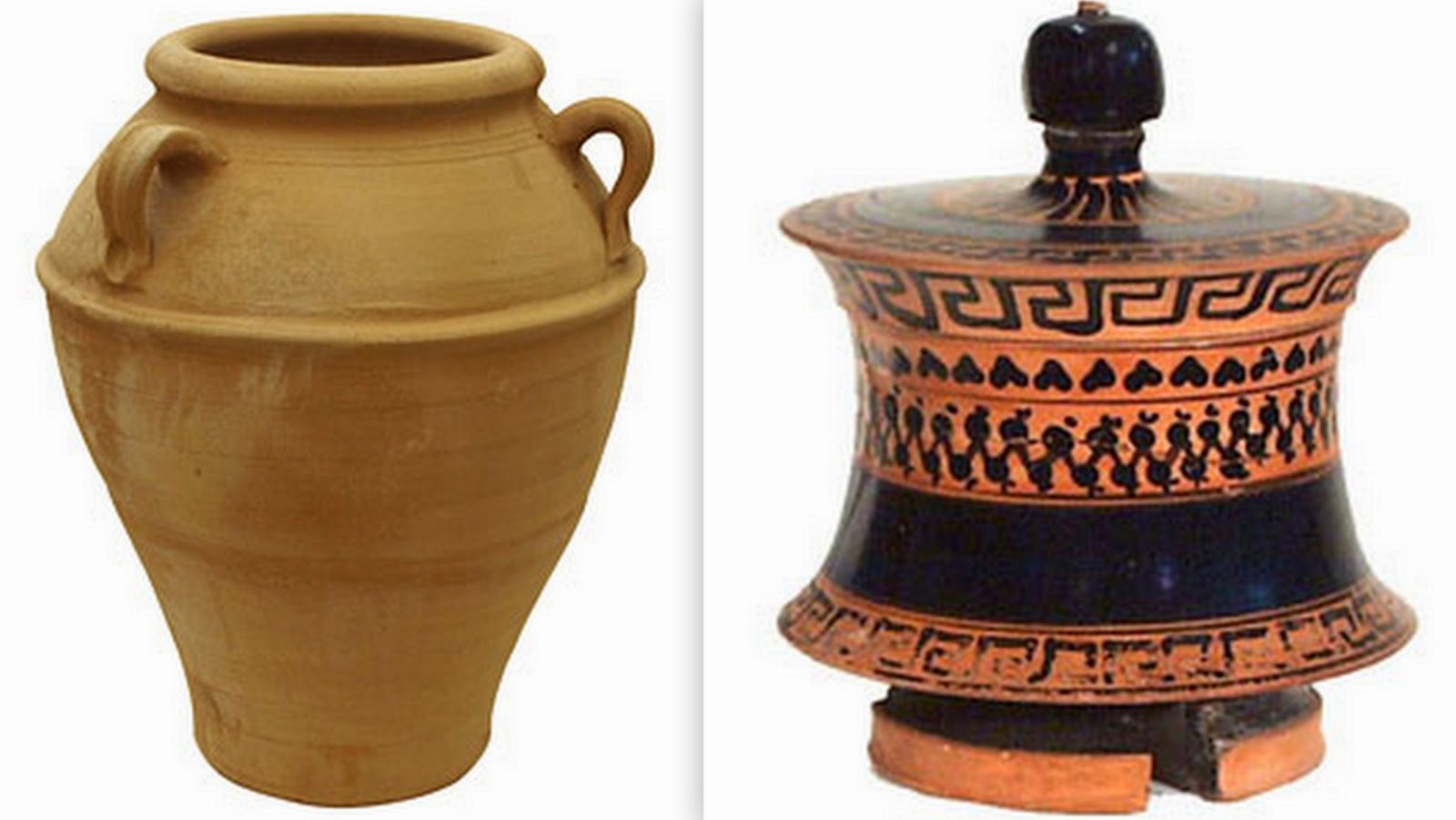
Surprisingly, the oldest Greek writings about Pandora reveal that the famous box wasn't a box to begin with. This part of the myth changed following the first translations of the texts into Latin, in the late 15th Century. Until that point in time, the myth was not broadly accessible among the scholars of Europe. Much later, it was discovered that a philological error occurred during the translation process, substituting the word pithos (a large cheramic jar, often depicted in Greek artwork) with pyxis (a cylindrical box, sometimes with a square lid), resulting in most future descriptions of the container as a box. The main individual responsible for popularizing this image was Erasmus of Rotterdam, with his his Adagorium Chiliades Tres, first published in 1508. 

Apparently there exists a few representations, slightly predating the latin translations, which show a tendency towards thinking of the container as a box. I haven't been able to find any of these, though.


A Greek Pithos (left) and Pyxis (right)

One could argue that the pithos-pyxis error is a good example of the powerful imagery of boxes: there is something inherently mysterious about them that can override original source material, even in the hands of scholars. On the surface this seems to be a valid point, and I believe that there might be something to it. But in this particular case there could be a more straightforward reason for the mix-up. It may have been because of another Greek myth, which includes many of the same elements as that of Pandora: the story of Cupid & Psyche.

Psyche was the youngest of three daughters, and one of the most beautiful women that had ever lived. According to the myth, she was so beautiful that her admirers forgot to make offerings to Venus. Some even went as far as declaring Psyche the second coming of the goddess of love. Consequently, Venus became jealous and angry and, drawing on the assistance of Cupid, forced a series of trials upon Psyche. In the final trial, Psyche is sent to Hades to gather some of Persephone's beauty. Psyche is given a pyxis for the purpose, with which, long story short, she manages to complete the mission. But on the way back to the surface, she is overwhelmed by curiosity and desire to aquire some of the beauty for herself. Unable to resist the temptation, she opens the box, and vapors are released which causes her to faint. She only completes the trial with the help of Cupid, who quickly comes to her assistance. Afterwards, Cupid and Psyche get married and have child together: Pleasure.


John William Waterhouse's  Psyche Opening the Golden Box (1903). Again we see the modern tendency of depicting the container as a square box.

We also have a Greek myth involving Athena, the goddess of war and crafts, and a box. There are several versions of it, but the main details are more or less the same:

Once, when Athena had come to Hephaestus for some weapons, he lost all his inhibitions and tried to rape her. Athena was determined to avoid this encounter and defend her virginity, and in the end Hephaestus missed his mark. The semen instead became Erichthonius (who would later become king of Athens), who in some accounts is described as a serpent, and in others as half snake/half man. Athena put Erichthonius into a box, in order to keep his existence a secret, and gave it to the three daughters of Cecrops (another serpentine human, and the first ruler of Athens). She did not tell the daughters what was inside, only that they were never to open it. As you might suspect, the daughters did not obey, and when they saw Erichthonius they went insane and/or fled in terror and killed themselves. 

One version of the myth mentions the daughters turning to stone by the gaze of Erichthonius, which leads us to think of both Medusa and our old friend the basilisk.


Cecrops' daughters open the lid of the "box" - here depicted as a basket - and finds the serpent child Erichthonius inside. Painting by Jasper van der Lanen (c. 1620)

Additionally, the following myth was probably inspired by the above, or vice versa:

Acamas, son of Theseus and Phaedra, was among the soldiers who conquered Troy. Following the siege he married Phyllis, but soon after left her, with a promise that he would return. Phyllis presented him with a departing gift, a box which she told him never to look into, no matter what. Acamas of course broke the promise, and what he saw inside the box horrified him so much that it led to his death. 

Finally there is a myth in which Athena takes the heart of Dionysys - who had just been killed by the Titans - puts it in a box, and delivers it to Zeus, who then revives him.


Boxes All Over The World


Moving outside ancient Greece, we find no shortage of myths centering around boxes. For some reason these are particularly prevalent in Native American mythology, especially in tales involving trickster figures. One of the most well-known of these boxes appears in the description of the North American Trickster:

Even though primarily male, he not only masquerades as a female but actually gives birth to children. He normally keeps his detached phallus in a box and is thus self-castrating (like many Greek androgynes); in order to have sexual intercourse, he removes the phallus from the box and sends it to the woman. (Jones, 490:2005)

In the above quote, a reference to Greece is given to us for free. But even without it, anyone should be able to spot the thematic similarities between this and the "serpent" Erichthonius in Athena's box. More about this later.

A trickster myth including not just one box, but several, is the one popularly known as "Raven Steals the Light". In it, the trickster Raven, who has just finished shaping the land and the seas, decides that he needs light to further advance his work. The light, however, was kept in the house of "The Sky Chief", hidden in three boxes - one including the stars, the other the moon and the third the sun. Raven tries several methods for entering the chief's house without being detected. He finally transforms into a baby and tricks the adults in the house to let him play with the boxes, one by one - but only if he promises not to open them. Raven does exactly that as soon as he gets the chance, and according to the myth, that is why we have those three sources of light in the sky today. 

A similar myth involves Coyote, only with two boxes - one with the moon and one with the sun inside.


The Raven Steals The Light by Bill Reid (1984)

Another tale worth mentioning is the Cherokee legend about "The Daughter Of The Sun". In it, the Sun complains to her daughter that the people on earth are not treating her with proper respect. Why will they never look at her? And when they do, why do they squint their eyes? Why are they always complaining about the heat she emits? One day the Sun had had enough and announced that she would kill off everybody. She went about doing this, but soon faced retaliation by the Cherokee:

The people appealed to some medicine men, called the Little Men, who came up with a plan to kill the Sun. They transformed two men into a copperhead Snake and an adder and instructed them to wait by the Daughter of the Sun’s door and attack the Sun with their venom-filled fangs. But the Sun’s rays blinded the snakes and rendered them helpless. The Little Men tried again, this time changing two men into more powerful snakes: the great horned serpent Uktena and a large rattlesnake. When the Daughter of the Sun opened her door, the rattlesnake got confused and bit her. By the time the Sun arrived, her daughter was dead and her soul had flown off to the Ghost Country, in the dark land of death called Ushunhi-yi. The Sun was so grief-stricken, she shut herself up inside her daughter’s house and cried for weeks. Instead of being glad she was gone, the people quickly realized how terrible it was not to have the Sun’s rays to warm and brighten the Earth. 
Once again, they consulted the Little Men, who advised them to send their bravest and smartest men to bring back the daughter’s soul from the Ghost Country. They were given a box to take her home in and warned not to open the lid until they reached the Daughter of the Sun’s house. The men followed the instructions and successfully retrieved the soul, but on the way home, they could not resist the ghost’s pleading for a bit of air. When they lifted the lid, her soul flew out and turned into a redbird. When the Sun found out, she cried so much that she caused a great flood on the Earth. The people then did everything they could to please the Sun, singing and dancing, drumming, and praising her beauty. After a time, the Sun forgot her grief and smiled, happy that the people were finally treating her with respect and love. (Lynch & Roberts, 32:2010)

Symbol allegedly related to the Daughter Of The Sun myth

This myth has some interesting details besides the box element. We again find a heavily serpentine theme, and that of the temptation of opening the box. And what about those little men creating the snakes? No doubt one could draw a parallel between them and a certain group of popular aliens, but I'll have to ask you to speculate further on that for yourself, at least for now.

Parts of the Inca creation myth also deals with boxes containing the light of the world. Especially one passage, included in The Handbook Of Inca Mythology (2004), is very interesting in this connection:

Just before the Spaniards appeared, the deity Cuniraya Viracocha journeyed to Cuzco to talk to the Inca Huayna Capac about how to divide the kingdom. There he persuaded Huayna Capac to go to Titicaca where Cuniraya would reveal himself. At Titicaca, the Inca was instructed to “mobilize your people so that we may send magicians and all sorts of shamans to Ura Ticsi, the world’s lower foundations”. A condor shaman, a falcon shaman, and a swift shaman who were imbued with the power to give form and force (camac) set out with the intention to return with one of Cuniraya’s sisters. The swift shaman arrived first and was warned not to open a small chest, as this was the prerogative of Huayna Capac. 
Close to Cuzco, the shaman could not resist looking inside the box: “Inside it there appeared a stately and beautiful lady. Her hair was like curly gold and she wore a majestic costume, and in her whole aspect she looked very tiny. The moment he saw her, the lady disappeared. And so deeply abashed, he arrived at the place called Titicaca in Cuzco”. The swift shaman brought the woman back to Huayna Capac and Cuniraya. While escorting her back, the shaman only had to speak and a table with food would instantly appear. He delivered her on the fifth day to Huayna Capac and Cuniraya Viracocha who were both overjoyed. Before opening the chest, Cuniraya said: “‘Inca! Let’s draw a line across this world. I’ll go into this space and you into this other space with my sister. You and I mustn’t see each other anymore!’ he said as he divided the world”. He began to open the box. At that moment, the world lit up with lightning.


Illustration showing Huayna Capac carrying what looks like a box, but is actually a shield

The above myth resonates a lot with the Japanese Utsuro-Bune stories, which I covered In Part 1. In retrospect, I would have to say that there is probably much more of a classical mythical element to those stories than I could initially comprehend. Jacques Vallee and Chris Aubeck also allude to this in Wonders In The Sky, where they trace the stories back via centuries-old Japanese folklore. And Japan certainly does have a lot of other stories involving mystery boxes.

Consider the following Japanese folk tale of Urashima Taro, known also as the "Fisher Boy Tale", which is often compared to that of Rip Van Winkle:
Urashima was fishing one day when he caught a large tortoise in his net. Feeling sorry for it, he cut the tortoise loose, freeing it to return to the sea. But the creature was actually one of the daughters of Ryujin, the Shinto god of the sea. She spoke to Urashima, inviting him to come to Ryugu, the sea god’s palace. Not completely believing he was speaking to a tortoise, he agreed to go. As he swam he saw a vast and beautiful palace made of sea shells, coral, and pearls. When they arrived at the palace, the tortoise changed into a beautiful girl. Urashima fell in love with her, and they were soon married. But after four years he felt homesick, and asked to go home to see his parents.
Urashima’s wife gave him a box with magical powers that would allow him to return to her when he wanted—but only if it remained closed. Back on land, Urashima found that much had changed. His parents were long gone. Finally in confused desperation, he asked an old man if he had known Urashima. Urashima, said the old man, drowned in the sea 400 years ago. Urashima, though he had hardly aged at all, had been away for 400 years. His parents and all his friends were long dead. Stunned, he opened the box, forgetting his wife’s warning not to. Instantly, he aged and disappeared into dust. (Roberts, 145:2010)


There are other variations of the story, among them one where only 300 years has passed, where the female is indentified as "Dragon Princess", and some in which Urashima opens the box and is enveloped in a mist. Actually, the story plays into a larger tradition of Japanese sea myths, originating with Benten, or Benzai-ten, the Japanese sea goddess, who is described as either riding a dragon while playing a harplike instrument, or swimming through the water in snake form and/or assisted by a group of white sea snakes. So, once again we have a serpentine connection.


To sum up...


I could have included quite a bit more mythological material in this post, but I think it would have be overkill to do so. At some later point, when the proper context arises, I will surely highlight more of these myths. For now, I hope to at least have established some of the common features I have found, and created a tentative link to more recent stories (UFO cases included) involving boxes. This link will become more obvious as we move along.

In an attempt to draw together some of the collective traits of the myths mentioned in this post, we can at least identify a few main themes: 

  • The most consistent theme would have to be that of temptation - the irresistable feeling of looking into that which must remain unseen, despite explicit warnings against it. The prevalence of this is perhaps not so strange, if we think of it as the common human weakness that it is. The inclusion of this element as part of a learning process makes sense, if we view it as a beneficial lesson for more or less any stable society.
  • There is also a clear serpentine theme running through many of these myths, but whether this is coincidential or not I can't say. It is something which appears so often, that it might well be impossible not to encounter it when comparing stories from the ancient world. What is fairly well established, on the other hand, is the link between reptiles and temptation. So in that sense, the connection is both interesting and meaningful. The serpentine theme most definitely has sexual connotations, and as we shall see in a later post, boxes are often interpreted as symbols of female sexuality.
  • The detail about mist and vapors being emitted from boxes, or containers in general, is relatively consistent throughout many of the myths, as well as in the depicitions of these - just scroll up and look at some of the images i have included. It is also an element that is found in many UFO cases which include boxes (but also many which do not), and one that I will spend a lot of time on in the near future. 

Finally...regarding the word "box": I have used it only when it was mentioned as such in the sources listed below. The weakness is of course that I don't know if that was directly what was mean't in the original texts. On the other hand, a big part of this research is to identify the "boxification" process that has occured, especially in modern times. After all, it is the more broadly accessible material that has the most influence on further retellings.


Sources:

  • Bastian, Dawn E. & Mitchell, Judy K.: Handbook Of Native American Mythology. ABC-Clio (2004)
  • Brisson, Luc: How Philosophers Saved Myths - Allegorical Interpretation And Classical Mythology. University Of Chicago Press (2004)
  • Coleman. J.A.: The Dictionary Of Mythology - An A-Z Of Themes, Legends And Heroes. Arcturus Publishing Ltd. (2007)
  • Cotterell, Arthur: The Encyclopedia Of Mythology - Classical, Celtic, Greek. Anness Publishing/Hermes House (2006)
  • Eason, Cassandra: Fabolous Creatures, Mythical Monsters And Animal Power Symbols - A Handbook. Greenwood Press (2008)
  • Grant, Michael: Myths of the Greeks and Romans. Meridian (1995)
  • Jones, Lindsay (ed.): Encyclopedia Of Religion (2nd edition) vol.1. Thomson Gale (2005)
  • Lynch, Patricia Ann & Roberts, Jeremy: Native American Mythology A to Z (2nd Ed.). Infobase (2010)
  • Panofsky, Dora & Erwin: Pandora's Box - The Changing Aspects of a Mythical Symbol. Routledge & Kegan Paul Ltd (1956)
  • Radin, Paul: The Trickster - A Study In American Indian Mythology. Philosophical Library Inc. (1956)
  • Roberts, Jeremy: Japanese Mythology A-Z (2nd Edition). Chelsea House Publishers (2010)
  • Roman, Luke & Monica: Encyclopedia Of Greek And Roman Mythology. Facts on File (2010)
  • Steele, Paul R.: Handbook Of Inca Mythology. ABC-Clio (2004)