Saturday, May 9, 2015

UFO's Over Copenhagen - A Case Of Hidden Contact?


This post is based on an article I wrote for a 2012 issue of UFO-Mail, the official organ for SUFOI (Scandinavian UFO Information), about a very unique Danish UFO case that I investigated a few years earlier. Besides just translating the article to English I have added some further details and comments to the main body of text, as well as to the conclusion. All names of those involved have been changed, for the sake of anonymity.


I came across the following story about 5 years ago, in the spring of 2010, while I was still at university. At the time I had been working on a larger research project for over a month, together with a fellow student who we can call Christian. On one occasion during a break, the talk turned to UFO’s and what they could be. Looking back, it was probably Christian who brought it up, since I very rarely start conversations about the topic myself. It's not that I’m embarrassed about my interest in UFO's, but simply because there are exhaustingly many layers you have to cut through every time you present your views, to people who mainly have their knowledge of the subject from documentaries etc. Still, I must take part of the responsibility, as he could hardly have failed to notice the many books about UFO’s I had lying around.
 

Anyway, after having talked about it back and forth for a few minutes Christian suddenly remarks: “Hey! I just remembered that my wife once saw a UFO!”. I was of course surprised and a bit intrigued, but didn’t really expect anything major. For all I knew, and from the little Christian could remember of her story, she might just have seen a strange light in the sky one night. But, as I was soon to learn, it was something a lot more dramatic than that. Furthermore, this came along right when I was most engulfed in reading about such cases. But let’s not get ahead of ourselves. At this point, not knowing very much, I asked Christian if he could tell his wife, Marianne, that I had a serious interest in UFO’s, and ask her if she was willing to share her experience with me some day. A few days later he had made arrangements for me to speak with her.


Marianne’s Close Encounter


Marianne’s UFO encounter took place sometime during the mid-1990’s – possibly in 1996. That’s about the closest we have come to putting a date on it. At the time she was living in an apartment on Carit Etlars Vej, in the western part of Copenhagen (actually in the city-within-the-city known as Frederiksberg). Her apartment was special, in that it had one of the only two French balconies on the rear end of the building - Marianne’s being on the fourth floor and the other just below it, on the third floor. In fact those balconies are the only two openings in the building facing in that direction, period.

The building housing Marianne’s former apartment. Her balcony was the top one, on the white facade of the building to the left.

The immediate view straight from the balcony is a medium-sized, red-colored apartment complex which partially blocks the view of a heavily trafficked road, Vesterbrogade. I couldn’t get both buildings to fit properly into one shot, so I took two separate pictures. There is some distance to the complex from the balcony, and in between is a small, cooped-up, ball court which is visible on the photo above and the one just below.

The back of the red apartment complex. You can see the ball court that separates it and the building housing Marianne’s apartment, to the left in the picture.
Although we haven’t been able to determine the exact year of the encounter, there can be no doubt that it took place in the summertime - possibly in June or July – during the the late night/early morning hours. She remembers that it was getting bright outside and the birds were singing. Due to the really humid climate around that time, she had pulled her bed all the way up to the balcony only a few days before, in order to get as much fresh air as possible. 

Suddenly, for some reason she can’t recall – or maybe there was no particular reason - Marianne looked out the balcony window. There, immediately outside, hovering above the ball court, was an object of bright aluminum complexion, without any visible windows or doors or other distinguishable features. Anne says that the “body” of the object was about 5-6 meters long, and the “wings” maybe 1.5 meters each. The things that attached the “wings” to the body seemed to her like some kind of pipe system. She made a sketch of it which you can see just below.


Marianne describes the rest of the experience as if time itself started to fall apart, or as if two different timelines were moving along at the same time. The object was moving, but very slowly. She noticed that all sounds and smells now disappeared, almost as if her surroundings faded away from her, and she felt that her sense of space and time was the only “real” thing present - all tell-tale signs of what British veteran ufologist Jenny Randles has dubbed the Oz Factor

Eventually the object began moving to the right, around the corner of the building. According to Marianne it should have been visible from the kitchen window immediately afterwards, but when she ran out to look it wasn’t there. Marianne isn’t sure how long the encounter lasted altogether, due to the strange state she was in, but she knows that it couldn’t have been that long because the sun hadn’t yet come up when it ended. She remembers that she was a bit scared, but most of all she felt that the object had been curious about her and that it was somehow “just passing by”.

An important part of the story is that Marianne's boyfriend at the time, Marco, was there with her during the encounter. He had been out partying pretty hard all night, but had arrived a short time earlier to crash at her place. Talking with Marianne, and later also with Marco, it became clear to me that the UFO encounter happened shortly after they had had sex that night/morning. Anne says that she remembers being awake for a little while afterwards, in a state of complete relaxation – very different from anything she had ever experienced before or since. Marco had fallen asleep almost immediately and was already snoring. She remembers that she tried her best to wake him up, but he was as far gone as the object now was. Marianne never saw the UFO again. 


Further Experiences


When I asked her about other unusual experiences, prior to or after her encounter, Marianne recalled a few very interesting things. One was an extremely vivid ”alien dream” she had a few nights later, in which she interacted with some very tall, golden ”super women” that looked like normal people, except for their height and large heads. In the dream she was supposed to help these beings with something, maybe a pregnancy. She also found some peculiar markings on her body, but doesn’t remember whether this only happened after the incident, or if it had also happened prior to it. She describes these markings as if they were indentations made by a hair brush. Curiously enough, while we were talking about all this, Christian suddenly broke in and stated that he himself had had those kinds of markings, more than once. He thinks that he may even have had them before he met Marianne. He describes his markings as 5 small dots, in a dice-like pattern. Christian also remembered calling Marianne his “intergalactic star goddess” one of the first times he met her, after falling in love with her. This was before she ever told him about her UFO encounter and he has no deeper explanation for this choice of nickname. 

Later I also found out that Marianne has a thing about owls and has made more than one very detailed piece of artwork involving them. I asked into this and she couldn’t explain why, other than they just had some sort of meaning to her. Although I am hesitant to make a direct connection between this and Marianne’s encounter it bears mentioning, because owls have been appearing under odd circumstance to a lot of UFO experiencers (just ask Mike Clelland, who has been documenting his own and other peoples stories involving owls for years)   

The conversation had turned into something of a surprise for all three of us. Marianne and Christian had very rarely talked about these things before - and certainly never all of them, within a UFO context. For me it was incredible that I seemed to have stumbled upon one of those very cases of “hidden contact” that I had been reading so much about. At least, all of the details I was getting just seemed to fit so well with incidents of that type. At the same time I was cautious and did not try to paint a picture of alien abductions and hybrid programs, although it would have been very easy to jump in head first like that. In fact I tried my very best to not even mention the abduction mythos in that or any of our later talks, except when asked - and then only very hesitantly. Nevertheless the details just kept coming forward.

Next, I felt had to find out if there could be something about Marianne that made her particularly susceptible to unusual experiences. This was very much inspired by reading books by Jenny Randles and Kenneth Ring, which document that certain personality traits make some people more prone to UFO experiences. This also brought forward some extremely interesting details. Just for the record it should be stated at this point, that Marianne has never touched any hard drugs and only occasionally smoked a joint.


About Marianne


Marianne is now in her mid-to-late 30’s and is the mother of 3 children. Christian is the father of the 2 youngest, a son and a daughter, and Marco is the father of the oldest, a daughter named Natalie who is now in her teens. Marianne is a designer, and at the time I spoke with her she worked specifically with furniture design. She describes herself as having had strong creative urges ever since childhood. As a child she was extremely good at visualizing shapes in front of her and when she closed her eyes, she could instantly imagine complex figures retract and expand, almost like fractals, which she felt she had to shape and balance in order to keep them separated. She still gets these images once in a while, but she says that with time it went from being an ability to being more of a “feeling“ which she often gets just before falling asleep. She feels that if she could only train this ability properly she would be able to use it for so many things. She has thought about practicing transcendental meditation to help further this goal.

Marianne has also had several odd things happen to her throughout her life, but nothing that she ever thought of connecting with the UFO encounter. In kindergarten for example, she suffered from an unknown and perplexing condition, where she would periodically experience static in front of her eyes, as if tuning into a dead TV channel. The doctors ran a long series of tests on her, for epilepsy and other disorders, but never figured out what was wrong. After a while it disappeared by itself.

Next I asked Marianne, inspired directly by Jenny Randles' experiencer-checklist, if she often had vivid dreams of flying. She confirmed. In fact, for a long time during her late childhood and early adolescence she believed that she could actually fly, if only she concentrated hard enough on it. She told me that even today this can be a source of conflict to her because, in a way, she still thinks that it can be done, but at the same time she knows it isn’t supposed to be possible. She has to keep her thoughts in check once in a while, so she won’t get too carried away.

Another trait in encounter-prone personalities is the clear recollection of events stretching back to very early childhood, sometimes even late infancy. Marianne confirmed this part as well. For example, she vividly remembers her younger sister’s birth, even though she was barely 2 years old at the time. Natalie, the daughter of her and Marco, also has detailed memories from when she was only 1½-2 years old. 

The story, as it now stood, would have been interesting in and of itself. But as it turned out, it didn’t end there. There proved to be a very definite link between Marianne's encounter and her former boyfriend, which we shall now explore further.


Marco’s UFO Encounter


As you will recall, Marco never woke up in time to see the UFO outside Marianne's balcony. But when she drew a sketch of it one of the following days he completely freaked out, for a very good reason: he had had a sighting of what appeared to be the exact same object, many years earlier. I haven’t been able to find out precisely which date this happened either, but Marco thinks it was probably in the early summer of 1987 or 1988, although it could be as late as 1989 or 1990. What we do know is that on this day he was out rollerskating with a few friends on Eskildsgade, a street not that far away from Marianne’s old apartment (and incidentally, I found out later, also the street where Mike Tramp, who I interviewed not long ago for a completely different purpose, grew up). Marco and his friends had a thing back then where they would grab onto cars and roll with them up and down the street, and they had been at this for several hours when it was beginning to get dark. Marco remembers that around 21.00 he was standing in one end of Eskildsgade, next to the medium-sized public square called Vesterbro Torv, while his two friends were much further down the the street, closer to Istedgade

 
The street where Marco & friends where rollerskating. Marco was standing approximately where I took this picture, facing the same direction as the camera, when the object appeared.


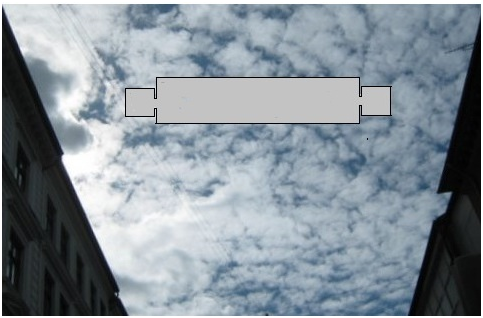
Around this time all three boys began noticing a loud, roaring sound coming from the air. Marco had trouble describing it to me, but according to him it was different than the sound of thunder. It was more like when a plane breaks the sound barrier, although even more powerful. Then suddenly, a 5-6 meter long grayish object, shaped sort of like a dumbbell or rolling pin, passes over his head, in the sky above the buildings. While the object flew over the street the sky was completely gray, but Marco distinctly remembers a pink, triangular patch of light in the distant sky, somewhere to the right (which could indicate an exotic weather phenomenon, but more about that later). As the object flew by, the streetlights and all other lights in the surrounding apartments went out one by one, and turned on again immediately after it had passed them. The object eventually disappeared into the horizon, but just before doing so it seemed to transform into a light.

 
A rough illustration (not correctly scaled) showing the object Marco saw, and the manner in which it flew forward. Marco estimated it to be about 40 meters above the buildings, but it kept itself in between them throughout its whole “route” of flight.

As can be seen on the above picture, the object was very similar to what Marianne observed years later, if not nearly identical to it. But the shape of the object is not the only element that recurs in Marianne’s encounter. As it turns out, Marco also tried everything he possibly could to get his friends to see the thing, but without success. They did not notice anything flying above them, although they do remember seeing a light disappearing in the distance. They also observed the electrical lights going off and back on again. In fact, one of them even heard a local radio show a few days later, where the host described an “unexplained blackout” that had taken place the night of the encounter. Even more interesting, like Marianne, Marco also felt as if time was distorted during the whole incident, and that the object somehow “sucked out” all the energy of its surroundings. He believes that, objectively, the whole experience only took about 20-30 seconds, but it felt a lot longer. Marco doesn’t think that there were any other people on the street who actually witnessed the object.

Marco describes the above experience as a turning point in his life. In retrospect he realizes that this was the one event that made him seek out a more spiritual lifestyle at a young age. He became a vegetarian instantly afterwards and has not eaten meat since. He also changed his personality from being a “smartass street kid” into a more sensitive and open minded person. When he saw Anne’s drawing and heard her recount her experience many years later, it felt kind of like redemption to him. Finally, someone had seen the same thing as him and he could know come to terms with the fact that it hadn’t just been a hallucination. One thing that he has wondered about many times since though, is why he never saw the object the second time around and why there was this strange temporal aspect to both his and Marianne's sightings. They discussed this many times afterwards and Marco distinctively remembers thinking that “time was against him” and that “something” prevented him from waking up in time to see the object. He also remembers Anne’s dreams about the aliens and speculated that there was a connection, even then.


Further Investigation


There were several things at this point that merited further investigation, but without any exact years to place the sightings, it was very difficult to approach them. In the case of Marianne I had hoped that at some point, a diary entry or similar would remind her of a more precise date. So far this hasn’t happened. Marco, likewise, who I have spoken to on several later occasions, can’t remember anything precisely about either of the two sightings, except the general time of year. Even after getting in touch with the friends he was skating with on the day of his encounter, we weren’t able to narrow it down much. Concerning his sighting, however, I have been able to work somewhat “backwards”. First I tried approaching local bars in the immediate area of the sighting, but in all of the places that existed back then (which weren’t many) the owners couldn’t pinpoint any power failures which had stood out particularly throughout the years. I did get the impression that it was something they had experienced quite often, though. I also began asking around in local shops, but quickly realized that it didn’t make much sense. Even if some of them did exist back then, they would surely have been closed at the time of the incident.

Next, I set out to look through local newspapers from the late 1980’s/early 1990’s, in order to find articles about power failures in Copenhagen – unexplained or otherwise. I figured that since it was apparently worth mentioning on the radio, there could have been a mention of it somewhere. However, searching both printed newspapers and Infomedia, a database covering a large section of Danish newspapers back to the 1980’s, has not yielded any useful clues.

Parallel to this, I tried locating a recording of the said radio program itself. I suppose I could have put up flyers all over the area of Vesterbro, in hope of finding someone who had an old cassette tape with the broadcast, but I wasn’t quite prepared for that. Instead I tried to find out what local radio station could have been the source of the announcement of the “unexplained blackout”. Marco helped me in the right direction on that one, and we discovered that it was probably one called Radio Ratatosk (now defunkt). After a short email exchange with the former administrator of the radio, a forwarded reply came back to me revealing that a former Radio Ratatosk host named Michael remembered a strange power failure in the late 80's, most likely after 1987 (but not whether he had talked about it on air). In any case, Michael told me that one day around that time, the power suddenly went out. For some reason he thought to himself “this is it. Chernobyl happening all over again”. Even stranger, when he picked up the phone to call a friend, the line was busy and full of voices. Then suddenly, the friend he was supposed to dial up was speaking from the other end. His friend had not tried to dial him either, and this was in the days before automatic callback was a standard feature on telephones. Michael then found out some time later, that the blackout was actually connected to the nuclear power plant, Barsebäck, which is located just across the water from Copenhagen, in southern Sweden. And if that isn’t enough, I also found out that Michael had an interest in UFO’s himself and was in contact with a lot of old characters from the heyday of Danish ufology. He could even tell me, that the last surviving member of a notable 70’s UFO cult lived just around the corner from me.

Eventually, although an interesting coincidence, I came to have my doubts about whether this was really the same blackout as the one during Marco’s encounter. They didn't sound like the same, since all the lights came on again almost immediately after the object had flown past them. But the sense that there was something about this area of Copenhagen that made it particularly susceptible to power failures, was further reinforced after my article was “printed” in UFO-mail. One of the reasons for putting the story out there in the first place, was to see if it would generate any useful clues to understanding the case better. I received a few replies in that regard, one of them an email from a reader who prefers to keep his name a secret. He wrote the following (translated from Danish):

In the 1980’s I became chief administrator for an organization with headquarters close to Vesterbro Torv (the square from which Eskildsgade is connected). From the late 1980’s until the middle of the 1990’s we experienced many short, unexplained interruptions of data transfer, typically during the night. We spent a small fortune trying to solve this problem, which was very damaging to us, but without any luck. The only explanation we were offered was that the interruptions were due to short power failures, despite the fact that we had the best UPS (Uninterruptible Power Supply) available on the market at the time. What the cause really was, we never found out. One day in the mid 1990’s, the problems suddenly stopped.

In light of Marco and his friends description of the power going shortly off and on during his encounter, the above account is highly interesting. It does indicate very strongly that there were some general problems with the electricity supply in the area around Vesterbro Torv during the 1980’s and 1990’s. I did try to follow this trail as well, but the main electricity provider at the time has long since been absorbed by the much larger company DONG, and contacting them was not very helpful at all. But I doubt that it would bring me any closer to a date for the Marco encounter anyways.  


Map showing some of the different places mentioned. The center of Copenhagen begins less than 1 kilometer to the right of  Vesterbro Torv.


Case Analysis


As readers can probably sense, this is a case that I have spent a lot of time on throughout the years. The reason is, as indicated earlier, that it presented itself to me at a time when I was really opening up to the complexity of the UFO phenomenon. In fact, I can think of no better example than this case to demonstrate just that complexity. I will (and can) not completely exclude that the object seen was some reconnaissance ship from another planet, keeping tabs on certain individuals while at the same time granting them exclusive experiences to further “their” own cryptic goals. I just think that when looking at the full picture - whether or not one accepts that both encounters are connected, which isn’t necessarily a given – the evidence points to several different answers. I also think it makes more sense to look at the individual elements on different levels.

On one level we have the undeniable physical aspects – the light in the distance, the power outage and the loud noise that both Marco and his friends saw and heard. I will go out on a limb and say that I think the odd pink, triangular patch in the distance, could also have been observed by others (in fact I plan on looking into this possibility in the near future). Along with the circumstantial evidence I received later on, this all indicates that something physical did in fact happen - it wasn’t all in the mind of one person. Furthermore it points to the area around Vesterbro Torv as being somehow electricity-sensitive.

On another level there is what seems like a purely individual and subjective part of the experience which, if we boil it down, only occurred to two people (that we know of, at least): Marco and Marianne. This is also where we find the most exotic descriptions – the shape and color of the craft, its movement, the time-warping, the sense of being watched, as well as the aftereffects that manifested (In Marco’s case, a complete change of lifestyle). In a way it seems like these experiences were meant only for these two people, and only one at a time.

But even though most of it seems very individual, how do we explain that so many of the core details can be found in both encounters?  Focusing on the personality traits of UFO experiencers that I mentioned earlier, which Marianne fulfills almost to a tee, some degree of deviation becomes apparent. Marco doesn’t seem to me as nearly the same kind of person. In fact I could only really pinpoint a few elements of experience-proneness that he somewhat conformed to. So if the whole case wasn’t already complicated enough, we also have to explain how Marco could have this experience to begin with, years before meeting Marianne, if he is not even the experience-prone type. Here again I think we should take note of the unusual weather conditions at the time. There are lots of other cases on record involving strange - in fact, often pink-colored - clouds, which include the same temporal distortions as Marco (and Marianne) experienced. Jenny Randles explored many of these in her excellent book Time Storms.

We also need to explain why Marianne suddenly saw what she saw, so many years later. She did not notice anything unusual about the weather, but did mention that it was extremely humid. This humidity could perhaps be linked in some way to a weather phenomenon similar to the one involved in Marco's encounter. Besides this, there is the aspect of Marianne’s experience occurring immediately after having sex with Marco. I left this part out in my original article for UFO-mail, but in fact I think it is highly relevant, whether or not one thinks of the case in “mystical” terms. Of course you might say that there is a good case for explaining Marianne’s sighting as an advanced after-effect of unintended sex magick, but even if this is uncomfortable for the more materialistically-oriented people out there to hear, I will suggest that it is not too far out to simply look at it in terms of an altered state of consciousness.

In addition to the above, we of course can not ignore the fact that Marco could have influenced her with the story of his own experience. In fact it is very likely that he did on some level, although neither of the two remember it. There were also many popular UFO movies, books etc. (X-Files was huge here around that time), which Marianne could have sought out for information. It was not my impression that she had even the slightest interest in those things, though, and the same goes for Marco, for that matter.


Conclusion(s)?


If asked to speculate freely, I would connect the dots in the following way:

  • Marco has a UFO experience at a young age that may or may not have been triggered, in part, by an exotic weather phenomenon
  • This phenomenon somehow interferes with both the electricity in the area and somehow also with his mind, creating an altered state of consciousness that makes him hallucinate a metallic object flying over him. It changes him, in fact so much that he becomes an almost different person afterwards, similar to people undergoing a mystical experience.
  • Years later, he manages to affect Marianne – an encounter-prone person who has a unique ability to easily and vividly imagine geometrical shapes , just by closing her eyes –with ideas of this oddly shaped UFO. He might even have told her in detail about it on several occasions, without remembering it.
  • One night, one or more stimulations put Marianne into an altered state of consciousness. During this state she recalls the details Marco’s UFO so strongly that she actually believes she sees it in front of her.
  • This state of consciousness- the Oz Factor or whatever we choose to call it - may be so similar in “feeling” from person to person, no matter what initially triggers it, that both Marianne and Marco were able to have an experience in the same basic way.
  • Marianne, however, being the more encounter-prone type of person, has an even closer encounter with the “object” and experiences even more dramatic effects that Marco did.

There are of course still many aspects that are harder to explain, such as.

  • Why the distinct shape of this object and why did there even “have” to be one in the first place, that moved synchronously with the power outage?
  • Why does it appear to be “shielding” itself from more than one person at the time? One gets the feeling that these episodes happened exactly because no one else could see them, which was noted by both Marco and Marianne. Especially ‘Marianne said that she thought it was noteworthy, how the object could just about avoid detection from other people in the area, by appearing in front of her particular window.
  • Why did Marianne experience so many of both the physical and mental aftereffects that we see in abduction cases from the same period – and indeed still do – such as strange markings, dreams centering on aliens reproductive aspects and a fascination with owls? And more puzzlingly, why should Christian have indications of these too, perhaps even before meeting Marianne?

Whatever the final answer may be, this was the case where I finally realized, that putting only one or two tags on UFO's doesn’t always work. There are a variety of external and personal factors involved that can trigger unusual experiences, made up of imagery that people are not even aware that they have. The case also made me realize that this is actually what makes the investigation of close encounter UFO cases such an interesting – as well as creative – endeavor. As to what the true source of that creativity really is – that, in my opinion, is still not fully explained.

Sunday, February 22, 2015

Fairy Castles In The Sky

Mirages have fooled even the brightest minds over the years, and none more so than the Fata Morgana. "Fata Morgana" is Italian, and denotes the most complex of mirages appearing over the horizon, made up of multiple images, and often with high levels of dynamics and detail. The term itself has an interesting etymology: "Fata" means fairy, "Morgana" derives from Morgan le Fay, and "La Fata Morgana" literally means the same as in French: "The Fairy Morgana". It was once believed that mirages were acts of magic, performed by the devious Arthurian sorceress in order to lure sailors to their death. The specific Italian connection stems from the fact that these mirages have been seen all throughout history in the Strait of Messina, the narrow patch of water that seperates the southern tip of Sicily and Calabria. The term was adopted into English in 1818, specifically because of observations from this area.


A modern example of a Fata Morgana. It's easy to see how these distortions can fire up the imagination. For a more technical description and more images, see here.

Rummaging through the Danish newspaper archives, I've discovered several stories that, apparently, involve Fata Morganas - all from different parts of Denmark. What struck me as curious about these observations, besides the great level of detail, is the fact that they all describe castles. Now it's not as if this country doesn't have its share of castles, but to have them appear in every instance does seem like more than just a coincidence. 

Imagine my surprise, then, when i discovered that one of the most well known features of the Fata Morgana, one that is closely related to the Morgan le Fay legend itself, is the appearance of castles. However, these "castles", in most historical cases, were most likely distortions of the reflections of objects other than castles. They probably came to be interpreted as such, due to the most basic mechanisms of pareidolia (take a look at f.x. the above photo, and it will become clear why), but there are some quite complex and detailed examples on record too. The Danish observations I have found, would seem to be among these.

In the July 20th, 1860, issue of Nykjøbing Tidende the following scenario is recounted: 

Last Wednesday, a Fata Morgana was seen at Nykøbing Mors. To the right was seen a forest area, to the left mountains, and in the middle a church and the ruins of a castle. The mirage was seen for about 15 minutes.

The next two stories were both brought in Ebeltoft Avis during the summer of 1887. The first, from May the 20th, includes even more detail than the previous article. It is also unique in that it takes place at night. I'm not sure how that would work, given the usual circumstances necessary for creating Fata Morganas, but then again, the term is not actually mentioned in this case. But in all other aspects, it fits the same pattern:

The other night, at 9.30, an aerial sight was observed in the southwestern sky from Hjørring. According to Vendsyssel Tidende, a castle could be seen in the clear moonlight - in one direction stood its tower and in the other end it was in ruins. From the castle a road went out, on which two wagons were driving - the movements of the horses clearly observable. After a short while the two wagons seperated, one driving onto a side road.

Ebeltoft Avis, May 20th (1887)

1½ months later, on July 6th, the following article appeared:

On Saturday afternoon between 4 and 5, a beautiful mirage was seen from Ælsegårde. At first a rocky landscape became present, in which appeared churches, castles, and houses. But after some time this changed and it was as if Møns Klint, with the dark outline of forest on top an (indeciperable) down the white cliffs.

I am unable to understand the last part of the above article properly, but it does appear as if there was some acknowledgement of a distortion taking place during the observation. Also, the descriptions of castle ruins in the two previous accounts, could be a way to account for irregularities in the scenery. But otherwise, the sightings appear to have been quite clear and almost of a visionary quality, especially the nightime observation. This is entirely possible, because even though the articles mention mirages and Fata Morganas, we don't know if the phenomenon (or term) was known to the observers, or if it was employed solely by the newspapers. This could just have been speculation, in order to demonstrate a scientific angle, but, maybe especially due to the the description of castles, one can understand quite well why a Fata Morgana would have come to mind. Another thing that strengthens this hypothesis, is that all the observation areas mentioned in the articles, are close to the sea. The bottom line, however, is that we can't know for sure.

But whether or not these were mirages or "genuine" visions of other worlds, the sights themselves must have been quite amazing to behold. And one can justly speculate that they, and many others like them, were the basis of many campfire stories of fairy castles in the sky. Perhaps even the legendary cloud realm of Magonia can be traced back to such experiences?

Tuesday, February 17, 2015

How Funny Are Those Explosions?

Accidents have always happened, and when you go through a lot of old newspapers, you really get a sense of just how many times they also repeat themselves. The warnings your mother came up with when you were a child were definitely founded in fact, not just an expression of overprotectiveness. The amount of articles about scalded infants, children drinking drain cleaner and even grown men drinking acid by mistake, throughout the 20th century Danish newspapers, are astounding. I personally don't like dwelling on tragedies, but there is a small percentage of these stories that are truly head-scratching, where noone got seriously hurt. 

Take for example the case of the couple from Fredericia, who were out for a romantic walk one quiet summer night in 1946. Suddenly they spotted a light under a bench, which turned out to be a candle. Confused about the sight, they blew out the candle and sat down for a while. Shortly after they heard an explosion, and the woman lept to her feet with a scream. Some sort of projectile had hit her leg, creating a wound that, although not deadly, did command medical attention. As an explanation, the police speculated that some disturbed person had placed a bullet close to the candle, in hope of making it fire. But even if one manages to stretch the mind to accept that answer, it still raises a lot of other questions.


Strange explosion under a public bench (Aftenbladet, 1946)

One can also find several news stories about large explosive devices, appearing in the most unlikely places. What would make a sane person choose a landmine to kindle the family's kitchen stove, you might ask. Apparently, many people did this back during the last war, because the wooden outer shells of the mines were highly flammable, and because they were somewhat in abundance. It did happen that people forgot to pull out the interior once in a while, though. For example, one day  in September of 1945, where a man and his wife put a mine inside the stove and briefly went outside. Then came a large explosion from the house, where the couple's two children were sitting on a table close to the stove. Amazingly, they survived without injuries, even though the stove had been blown to bits, with parts sticking out from the walls and ceiling.


"A Landmine in the Stove". Apparently the locals started looking for alternatives, following too many of these incidents (Aftenbladet) 

Another incident, from Ryesgade, Copenhagen in 1919, demonstrates that these homemade explosions weren't always self-inflicted. A ceramic stove in a first-floor apartment exploded here one night in April, taking out all the windows and setting the furniture on fire. There were children present here too, but by some miracle they also survived without injuries. The source couldn't be determined in this case, but it was proposed that a firecracker had somehow found it's way into the coal-pile.


A bomb in the stove. Always check your coal for stray firecrackers and the likes (Aftenbladet, 1919)

The same level of innoncence could not proclaimed by a man, who in 1941 decided to discard of a firebomb by placing it close to his stove. There it laid for a long period of time, until people in the area heard about it and called the police. Fortunately for him and his neighbours, nothing happened here either.

Thursday, January 8, 2015

UBO's (Unidentified Box-like Objects) - Part 3


Let's take a few steps back from the previous post, to the years immediately before Kenneth Arnold's sighting of 1947. 

Many are not aware of it, but there are several accounts on record from the World War II period (some even further back), that fit the model of later UFO landing cases perfectly. For all intents and purposes, they are just that, but we have to be careful, as the majority of them were told many years after the fact. However, as i have said before, since these posts are more about finding trends rather than ultimate truths, any amount of later confabulation just shows something different about the origin of a given box, than what seems immediately apparent. In other words, as long as the details of how and when the stories came about are made as clear as possible, there should be no problems.


Typically, the humanoids encountered in these WW2-related cases, were interpreted as foreign soldiers at the time of the incident, and many of the accounts come from witnesses who were themselves active servicemen back then. The extraterrestrial hypothesis was a possibility that only dawned on these people years later, as the UFO-ET mythos became more established and popularized. 


Various boxes, during and immediately after World War Two


The first incident worth mentioning involved John Warren, who was a British RAF armourer during the war. It first 
came to light in BUFORA's research bulletin (vol. 4 no. 2, July 1973), in the form of a letter from Warren himself (every word and comma as printed in the bulletin):

In May 1943, I was stationed at R.A.F. Ludham in Norfolk, I missed my last train to camp, so I set off to walk 16 miles back. I was about 4 miles from camp in the country with no houses for maybe 2 miles, the lane I walked up was a slight bending right, when suddenly I saw a person standing at the edge of a field with something strapped non the chest which gave a glow to the face, greenish in colour. Believe me my hair stood on end I was terrified. I walked passed as best I could and half noticed about 20-30 yards away in the field was some kind of object, which seemed alight, in colours. I thought I saw two other persons probing about the ground near the object. I never spoke to the person I walked passed. I was shaking with fright. I never reported the affair to anyone at camp, I was about 2 1/2 hours late. I can describe it more in detail when I told it to my boys 20 years later.

The grammatical errors and inconsistencies make parts of the account hard to decipher. Did Warren mean he was 2 1/2 hours late, thereby implying some missing time, or did he just mean, that because he was late, he was less inclined to report it to his superiors? Furthermore, his last sentence is somewhat cryptic. Warren added more details 15 years later. In an interview with ufologist Philip Mantle from 1988, he recounted that the humanoid he saw most clearly, wore a greyish-white "boiler suit" and what looked like an oldfashioned diver's helmet or goldfish bowl. He described it's face as round, without any noticeable cheekbones or chin, and clearly states that the attached object that lighted it up was a box of some kind.

In this case, the box did not appear to be of superior technology. Instead, it seems to have served no other function than to make certain that the face of the disturbing entity was visible, which in itself is unusual. Warren never specified who or what he thought the beings were at the time, but he makes it quite clear to Mantle, that the idea of spacemen never entered his mind.


Sketch of the grinning entity, made by John Warren in connection with the 1988 Philip Mantle interview. 

The next account is often filed as a crash and retrieval case, and has been covered by Leonard Stringfield and others dedicated to this particular area of ufology. It can be viewed as such, I suppose, depending on how much of the story one reads (and believes in):

A year after Warren's encounter, on the 18th of June, 1944, US Navy engineer Edward Langer claims to have encountered a group of 7 humanoids, including a captain, standing near a spherical craft. This happened while he was walking on a beach near Kaneohi Naval Air Station, in Oahu, Hawaii. The beings were approximately 4.5 feet tall, had short haircuts, dark eyes and eyebrows (one of them had fangs) and wore olive-green, one-piece suits and belts with black boxes attached to themLanger got into a fight with one of them and threw him to the ground, whereafter the rest seized upon their fellow crewmember, and eventually, on orders of the captain, killed him. This apparently earned Langer the respect of the captain, who arranged to meet him the following day

Langer claimed that he managed to steal the belt-box of the dead crew member before leaving, but that it was confiscated shortly afterwards by the OSS, FBI, and Naval Intelligence. Who eventually ended up with the prize is unclear, but according to Langer it was later used in an experiment to melt a cat (!). Again, all this was never officially recounted until many years later, around roughly the same time as Warren broke his story. In Langer's case, he contacted ufologist Don Worley. Worley appears to have lost contact with Langer before getting the whole story, though.

Langer originally thought that the beings belonged to a special submarine unit, so again, the possiblity of unearthly origin did not immediately enter the picture. But in this case, the witness met with the beings the following day, where he was told about their home planet and what they were doing on earth. 


Donald "Don" Worley, the first ufologist to learn of the Oahu incident

On Christmas day, 1945, a farmer on an island off the west coast of Ireland allegedly witnessed his dog being hypnotized by an entity coming out of a silvery craft. This case has been highlighted as an early example of the connection between UFO's and cattle mutilation, but we are more interested in other details: 

The witness was standing on the shore in a blizzard, waiting for a boat to return to the mainland, when a silver dome with a square base descended from the clouds and landed on the water. It was surrounded by purple lights and made a whirring noise like a drill. It rose again & landed in a field, crushing two cattle. The top slid up, & 2 humanoids with “squarish legs,” wearing gray black rubber suits, came out. One of these walked to the shore & onto the sea, where he placed a large phial. The other fired a red ray at a cow, burning through it. A farmer’s dog came up, barking; the humanoid pointed “a box with lights & antenna” at it, and the dog, apparently hypnotized, walked up to the UFO & was put on board. 5 or 6 similar craft streaked overhead. A mist then enveloped the craft & both beings “floated” up into it. One noticed the witness & waved at him; he ran from the scene. The farmer advised him to tell no one about the experienced. (HUMCAT 1945-4, Source: Northern UFO News # 31)

According to Albert Rosales, the case appears in a somewhat different version in the book Conspiracy Of Silence - UFO's In Ireland. Until i get my hands on that book, I'm going to just take a wild guess that this account, like the previous two, was related many years after it happened. It would be particularly interesting to learn if there is a record mentioning the box, from before 1970 (year of the Imjärvi case). In the Warren and Langer incidents we know they came out in 1973 and 1974 respectively, when the box trope (a new term I've learned recently, courtesy of Bob Skinner) had really kicked off. 

The last case for now, is yet another of these late revelations, but it has been so extensively documented that it deserves a long chapter of its own: The Gösta Carlsson encounter from 1946.


The mysterious box in the clearing


Gösta Carlsson (1918-2003) was a nationally famous Swedish athlete and businessman, who in the 1950's founded the succesful company Cernelle, known primarily for producing natural medicine based on pollen extracts. This endeavor earned Carlsson the nickname "The Pollen King". Many years later, in 1971, Carlsson came out and told where he really got his inspiration for the medicine: it could all be traced back to an encounter with a landed spacecraft and its occupants, in the southern part of Sweden, in the summer of 1946.

The Gösta Carlsson story is not really that well known, even in ufological circles, although some may remember it being featured in Jerome Clark & Loren Coleman's classic 1970's book The Unidentified. The definitive investigation into the matter, however, was undertaken many years later by ace Swedish ufologist Clas Svahn, in close collaboration with Carlsson himself. This resulted in the excellent book Mötet i Gläntan ("The Meeting in The Clearing"). The book is only published in Swedish (which is why many of the details still remain obscure), and builds on Gösta Carlsson's own account - with critical interjections by Svahn throughout the book. 

For the non-Scandinavian readers interested in knowing more than what I write here, Svahn talks about the case at some length in a 2009 episode of Binall of America.


THE book documenting the Gösta Carlsson experience from every conceivable angle


The "Meeting In The Clearing" went like this:

On the 18th of May, 1946, at around 22.00 military time, Gösta Carlsson was visiting one of his favorite spots: the beach area called Sibirien (Siberia) near the small town Ängleholm (not far from the city of Helsingborg). This was, and still is, a great place for watching birds, and Carlsson himself had a secret dream of some day making the area into a bird sanctuary. Around 22:45 it became dark, and he began riding his bicycle back towards Ängelholm, through the woods surrounding the beach. At some point he looked towards a large grass clearing which he often visited as a kid, and noticed a strange light. 
Carlsson used a small headlight to make his way through the woods into the clearing. When he reached the area, he was surprised to see a large object, which he at first interpreted as some kind of ride you would find in an amusement park. But it turned out to be something very different. 

The object was saucer-shaped, with some kind of antenna on top, and a ladder coming out of the bottom. Around it, several human-like figures, both men and women, were engaged in what seemed like repairs on the craft. At first, Carlsson tried to convince himself that they might be German soldiers, but deep inside he didn't really believe it. He did wonder whether or not it was a secret weapon of sorts, though. 

There was a smell of ozone in the air and the area around the craft was lit up in a strange manner. For some reason he couldn't hear a sound from anyone inside the lighted area, only from outside it, where he and one of the humanoids was standing. This male humanoid was wearing what looked (in retrospect) like an astronaut suit, and a headpiece like that on a raincoat. Carlsson sensed that he was a guard of sorts, posted to make sure that noone came closer to the craft. Around his neck, hanging in front of his chest, was a black box-like device which Carlsson interpreted as similar to the folding camera's that were popular at the time


Rough sketch of the box, made by Gösta Carlsson (Copyright: Clas Svahn)

Vintage Folding Camera

Carlsson was now standing 10 meters from the craft itself, and about 7-8 meters from the guard. As soon as he tried to get closer, the guard signalled him to stop, and turned the box-like device towards him. Whatever the device's function was, it affected the circuitry of Carlsson's headlight. Carlsson stood back and remained observant, but when a female crew member began handing out what looked like drinks, he once again became curious and moved in closer. The guard now turned to him with a firm look in his eyes and a hand gesture that signalled: "Stop. No further". The rest of the crew were also looking seriously at him by now, as if something terrible would happen if he came too close. As soon as Carlsson took a step back, they resumed their activities.

  
Illustration by Olle Schön interpreting the scene, with the guard in front (Copyright: Clas Svahn)
After a while, Carlsson did something which seems irrational, but in fact occurs time and time again in these accounts; he left for the beach and decided to come back a while later. From the beach he tried to make out the area of the clearing though the woods, when suddenly a red glowing light appeared. It was the saucer shaped craft, which at first hovered a bit, but then finally shot off into the sky, with a whining sound. Carlsson's first thought was to go back to the clearing, but he discovered that his headlight had been fried, probably due to the box-like device. Instead he goes home, but returns again at daylight, after only a few hours of sleep. 

At the site he finds several traces from the night's event: a large circle in the grass, footprints and the cups that the drinks were served in. In the area he also finds a piece of violet quartz, a green ring and a curious rock. Furthermore, when he returns home to his wife, he discovers that his face is covered in a yellow substance: pollen. From this experience, as already mentioned, Carlsson would embark on a succesful business adventure. But another kind of adventure followed as well, as the characters of his strange encounter would appear to him several times over the years.

In Mötet i Gläntan, Clas Svahn looks into several elements of Gösta Carlsson's later experiences, and devotes many pages to exploring the mysterious box and its origins. Here he compares it to strange boxes appearing in other close encounter cases, including some that I have already covered, and others which will be included at a later pointThe speculations about Carlsson's box range from the technological to the psychological (including a potential unrecollected abduction scenario), ultimately leaning towards the latter. 

One of the reasons for this conclusion, is that after Gösta Carlsson's initial encounter, the camera-like box appeared to him on many seperate occasions, always right around falling asleep, as a kind of hypnagogic "dream-enabler""Sleep" and "dream" are perhaps not the best terms, as it was more like an altered state of conciousness. He would typically have an out-of-body type experience as a precursor, and then suddenly see the guard holding the camera box, transporting him into another setting where he would have further "contacts" with the beings from the clearing. Gösta describes it as if he was "sucked into the objective" and subsequently reappearing in the "dream", like a television turning on. These facts also led Svahn to conclude, that the initial encounter in the clearing was the only of Gösta Carlsson's UFO experiences that could really be attributed to any kind of physical reality. 

Some die-hard abductionists might object to this, but it's important to note that Carlsson himself found his later experiences to be of a parapsychological nature, and was convinced that noone else could have shared in his visions, even if they had been in the same room as him. Nevertheless, they were very real to him and affected him deeply. He also believed that the "original" box could have been the trigger of these visions. Supposing that the meeting in the clearing really happened, and involved extraterrestrials who live lightyears away, they would need a way to maintain contact over vast distances, if they wished to do so. Maybe the box helped establish such a link?


"UFO-Memorial" raised in 1972 by Gösta Carlsson to commemorate his encounter. The monument in the middle is downscaled - the circles around indicate the traces from the landing (that were beginning to fade away at the time) and thereby show the real proportions of the craft. I have visited the memorial many times, even slept there once (without experiencing anything extraordinary, though)

Many of the features of Gösta Carlsson's visionary experiences are found in other "bedtime visitation" type cases that include boxes. I am going to explore these more indepth in a later post. Perhaps already in part 4.


Main Sources:

  • Albert Rosales' Humanoid Catalogue
  • BUFORA research bulletin vol. 4 no. 2, July 1973
  • HUMCAT
  • Svahn, Clas and Carlsson, Gösta: Mötet i gläntan - Sveriges mest kända närkontakt med UFO. NTB/Pantheon (1995)
  • UFO Data Magazine Issue 4, June/July 2006)

- Special thanks to Albert Rosales and Ole Henningsen for supplying material, and to Clas Svahn for the permission to use images.

Sunday, January 4, 2015

Identified Box-like Objects (Part 1)


Readers of this blog will no doubt have noticed that I have a fascination with "mystery boxes", appearing with certain frequency across the UFO literature. This has so far resulted in the following posts: 


There are many more of these on the way, believe me. I have spent a lot of time gathering cases, finding internal patterns, and comparing them with each other. But an obvious and crucial part of this research has also been to look into external factors, that could have served as "inspiration" or functioned as contagious imagery - whether conciously or unconciously. 

This, then, is intended to be the first part in a series of "sister articles", dedicated to exploring these various avenues of influence. Along the way, I will attempt to show how this box element has appeared throughout the years, and how it eventually found its way into popular culture. These articles will be seperated, as much as possible, from the strictly ufological data for now. But the end goal is to bring both "tracks" together for a broader analysis. 

As a starting point, I will outline several ancient myths involving boxes with supernatural qualities, in order to establish a kind of mythological-historical background. 


Boxes In The Greek Mythological Tradition


One of the most famous mythical boxes in European and post-native North American culture, is surely that of Pandora. The reason for this is that it is still invoked, even in everyday situations, in the form of a popular warning; whenever there is a risk of unleashing a s***storm through a certain action, we talk about "opening up a Pandora's Box" of problems. Despite the box's popularity, very few are actually familiar with the story behind it, which is, in short, as follows: 


In Greek Mythology, Pandora (literally: "all-gifted") was the first mortal woman. She was created with the attributes of all the gods of Olympus - as an angry response to Prometheus' theft of fire - to be a cunning and skillful opposer of mankind. The god's supplied Pandora with a containment unit full of spirits (Daimons), which were later (unwittingly) unleashed through her onto mankind. These Daimons represented all the evils that have since plagued humanity, and only one of them - Hope - never left the container. 


There is a clear parallel here to the biblical Eve and the misogynistic "tradition" of viewing women as the source of all evil. It is also easy to see how the myth of Pandora's Box inspired the Scientologist creation story.


One of Dante Gabriel Rossetti's famous Pandora paintings (1879)

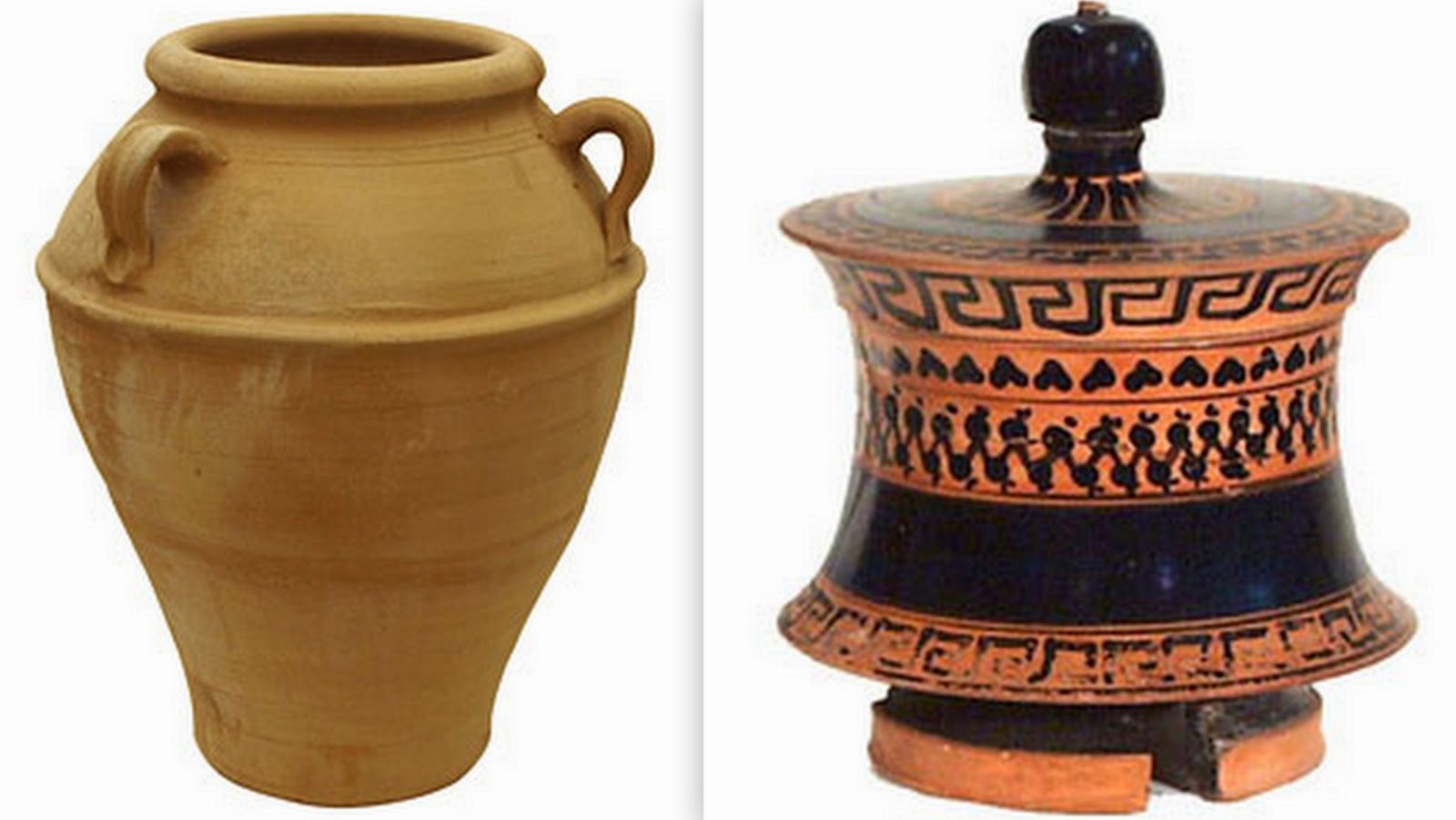
Surprisingly, the oldest Greek writings about Pandora reveal that the famous box wasn't a box to begin with. This part of the myth changed following the first translations of the texts into Latin, in the late 15th Century. Until that point in time, the myth was not broadly accessible among the scholars of Europe. Much later, it was discovered that a philological error occurred during the translation process, substituting the word pithos (a large cheramic jar, often depicted in Greek artwork) with pyxis (a cylindrical box, sometimes with a square lid), resulting in most future descriptions of the container as a box. The main individual responsible for popularizing this image was Erasmus of Rotterdam, with his his Adagorium Chiliades Tres, first published in 1508. 

Apparently there exists a few representations, slightly predating the latin translations, which show a tendency towards thinking of the container as a box. I haven't been able to find any of these, though.


A Greek Pithos (left) and Pyxis (right)

One could argue that the pithos-pyxis error is a good example of the powerful imagery of boxes: there is something inherently mysterious about them that can override original source material, even in the hands of scholars. On the surface this seems to be a valid point, and I believe that there might be something to it. But in this particular case there could be a more straightforward reason for the mix-up. It may have been because of another Greek myth, which includes many of the same elements as that of Pandora: the story of Cupid & Psyche.

Psyche was the youngest of three daughters, and one of the most beautiful women that had ever lived. According to the myth, she was so beautiful that her admirers forgot to make offerings to Venus. Some even went as far as declaring Psyche the second coming of the goddess of love. Consequently, Venus became jealous and angry and, drawing on the assistance of Cupid, forced a series of trials upon Psyche. In the final trial, Psyche is sent to Hades to gather some of Persephone's beauty. Psyche is given a pyxis for the purpose, with which, long story short, she manages to complete the mission. But on the way back to the surface, she is overwhelmed by curiosity and desire to aquire some of the beauty for herself. Unable to resist the temptation, she opens the box, and vapors are released which causes her to faint. She only completes the trial with the help of Cupid, who quickly comes to her assistance. Afterwards, Cupid and Psyche get married and have child together: Pleasure.


John William Waterhouse's  Psyche Opening the Golden Box (1903). Again we see the modern tendency of depicting the container as a square box.

We also have a Greek myth involving Athena, the goddess of war and crafts, and a box. There are several versions of it, but the main details are more or less the same:

Once, when Athena had come to Hephaestus for some weapons, he lost all his inhibitions and tried to rape her. Athena was determined to avoid this encounter and defend her virginity, and in the end Hephaestus missed his mark. The semen instead became Erichthonius (who would later become king of Athens), who in some accounts is described as a serpent, and in others as half snake/half man. Athena put Erichthonius into a box, in order to keep his existence a secret, and gave it to the three daughters of Cecrops (another serpentine human, and the first ruler of Athens). She did not tell the daughters what was inside, only that they were never to open it. As you might suspect, the daughters did not obey, and when they saw Erichthonius they went insane and/or fled in terror and killed themselves. 

One version of the myth mentions the daughters turning to stone by the gaze of Erichthonius, which leads us to think of both Medusa and our old friend the basilisk.


Cecrops' daughters open the lid of the "box" - here depicted as a basket - and finds the serpent child Erichthonius inside. Painting by Jasper van der Lanen (c. 1620)

Additionally, the following myth was probably inspired by the above, or vice versa:

Acamas, son of Theseus and Phaedra, was among the soldiers who conquered Troy. Following the siege he married Phyllis, but soon after left her, with a promise that he would return. Phyllis presented him with a departing gift, a box which she told him never to look into, no matter what. Acamas of course broke the promise, and what he saw inside the box horrified him so much that it led to his death. 

Finally there is a myth in which Athena takes the heart of Dionysys - who had just been killed by the Titans - puts it in a box, and delivers it to Zeus, who then revives him.


Boxes All Over The World


Moving outside ancient Greece, we find no shortage of myths centering around boxes. For some reason these are particularly prevalent in Native American mythology, especially in tales involving trickster figures. One of the most well-known of these boxes appears in the description of the North American Trickster:

Even though primarily male, he not only masquerades as a female but actually gives birth to children. He normally keeps his detached phallus in a box and is thus self-castrating (like many Greek androgynes); in order to have sexual intercourse, he removes the phallus from the box and sends it to the woman. (Jones, 490:2005)

In the above quote, a reference to Greece is given to us for free. But even without it, anyone should be able to spot the thematic similarities between this and the "serpent" Erichthonius in Athena's box. More about this later.

A trickster myth including not just one box, but several, is the one popularly known as "Raven Steals the Light". In it, the trickster Raven, who has just finished shaping the land and the seas, decides that he needs light to further advance his work. The light, however, was kept in the house of "The Sky Chief", hidden in three boxes - one including the stars, the other the moon and the third the sun. Raven tries several methods for entering the chief's house without being detected. He finally transforms into a baby and tricks the adults in the house to let him play with the boxes, one by one - but only if he promises not to open them. Raven does exactly that as soon as he gets the chance, and according to the myth, that is why we have those three sources of light in the sky today. 

A similar myth involves Coyote, only with two boxes - one with the moon and one with the sun inside.


The Raven Steals The Light by Bill Reid (1984)

Another tale worth mentioning is the Cherokee legend about "The Daughter Of The Sun". In it, the Sun complains to her daughter that the people on earth are not treating her with proper respect. Why will they never look at her? And when they do, why do they squint their eyes? Why are they always complaining about the heat she emits? One day the Sun had had enough and announced that she would kill off everybody. She went about doing this, but soon faced retaliation by the Cherokee:

The people appealed to some medicine men, called the Little Men, who came up with a plan to kill the Sun. They transformed two men into a copperhead Snake and an adder and instructed them to wait by the Daughter of the Sun’s door and attack the Sun with their venom-filled fangs. But the Sun’s rays blinded the snakes and rendered them helpless. The Little Men tried again, this time changing two men into more powerful snakes: the great horned serpent Uktena and a large rattlesnake. When the Daughter of the Sun opened her door, the rattlesnake got confused and bit her. By the time the Sun arrived, her daughter was dead and her soul had flown off to the Ghost Country, in the dark land of death called Ushunhi-yi. The Sun was so grief-stricken, she shut herself up inside her daughter’s house and cried for weeks. Instead of being glad she was gone, the people quickly realized how terrible it was not to have the Sun’s rays to warm and brighten the Earth. 
Once again, they consulted the Little Men, who advised them to send their bravest and smartest men to bring back the daughter’s soul from the Ghost Country. They were given a box to take her home in and warned not to open the lid until they reached the Daughter of the Sun’s house. The men followed the instructions and successfully retrieved the soul, but on the way home, they could not resist the ghost’s pleading for a bit of air. When they lifted the lid, her soul flew out and turned into a redbird. When the Sun found out, she cried so much that she caused a great flood on the Earth. The people then did everything they could to please the Sun, singing and dancing, drumming, and praising her beauty. After a time, the Sun forgot her grief and smiled, happy that the people were finally treating her with respect and love. (Lynch & Roberts, 32:2010)

Symbol allegedly related to the Daughter Of The Sun myth

This myth has some interesting details besides the box element. We again find a heavily serpentine theme, and that of the temptation of opening the box. And what about those little men creating the snakes? No doubt one could draw a parallel between them and a certain group of popular aliens, but I'll have to ask you to speculate further on that for yourself, at least for now.

Parts of the Inca creation myth also deals with boxes containing the light of the world. Especially one passage, included in The Handbook Of Inca Mythology (2004), is very interesting in this connection:

Just before the Spaniards appeared, the deity Cuniraya Viracocha journeyed to Cuzco to talk to the Inca Huayna Capac about how to divide the kingdom. There he persuaded Huayna Capac to go to Titicaca where Cuniraya would reveal himself. At Titicaca, the Inca was instructed to “mobilize your people so that we may send magicians and all sorts of shamans to Ura Ticsi, the world’s lower foundations”. A condor shaman, a falcon shaman, and a swift shaman who were imbued with the power to give form and force (camac) set out with the intention to return with one of Cuniraya’s sisters. The swift shaman arrived first and was warned not to open a small chest, as this was the prerogative of Huayna Capac. 
Close to Cuzco, the shaman could not resist looking inside the box: “Inside it there appeared a stately and beautiful lady. Her hair was like curly gold and she wore a majestic costume, and in her whole aspect she looked very tiny. The moment he saw her, the lady disappeared. And so deeply abashed, he arrived at the place called Titicaca in Cuzco”. The swift shaman brought the woman back to Huayna Capac and Cuniraya. While escorting her back, the shaman only had to speak and a table with food would instantly appear. He delivered her on the fifth day to Huayna Capac and Cuniraya Viracocha who were both overjoyed. Before opening the chest, Cuniraya said: “‘Inca! Let’s draw a line across this world. I’ll go into this space and you into this other space with my sister. You and I mustn’t see each other anymore!’ he said as he divided the world”. He began to open the box. At that moment, the world lit up with lightning.


Illustration showing Huayna Capac carrying what looks like a box, but is actually a shield

The above myth resonates a lot with the Japanese Utsuro-Bune stories, which I covered In Part 1. In retrospect, I would have to say that there is probably much more of a classical mythical element to those stories than I could initially comprehend. Jacques Vallee and Chris Aubeck also allude to this in Wonders In The Sky, where they trace the stories back via centuries-old Japanese folklore. And Japan certainly does have a lot of other stories involving mystery boxes.

Consider the following Japanese folk tale of Urashima Taro, known also as the "Fisher Boy Tale", which is often compared to that of Rip Van Winkle:
Urashima was fishing one day when he caught a large tortoise in his net. Feeling sorry for it, he cut the tortoise loose, freeing it to return to the sea. But the creature was actually one of the daughters of Ryujin, the Shinto god of the sea. She spoke to Urashima, inviting him to come to Ryugu, the sea god’s palace. Not completely believing he was speaking to a tortoise, he agreed to go. As he swam he saw a vast and beautiful palace made of sea shells, coral, and pearls. When they arrived at the palace, the tortoise changed into a beautiful girl. Urashima fell in love with her, and they were soon married. But after four years he felt homesick, and asked to go home to see his parents.
Urashima’s wife gave him a box with magical powers that would allow him to return to her when he wanted—but only if it remained closed. Back on land, Urashima found that much had changed. His parents were long gone. Finally in confused desperation, he asked an old man if he had known Urashima. Urashima, said the old man, drowned in the sea 400 years ago. Urashima, though he had hardly aged at all, had been away for 400 years. His parents and all his friends were long dead. Stunned, he opened the box, forgetting his wife’s warning not to. Instantly, he aged and disappeared into dust. (Roberts, 145:2010)


There are other variations of the story, among them one where only 300 years has passed, where the female is indentified as "Dragon Princess", and some in which Urashima opens the box and is enveloped in a mist. Actually, the story plays into a larger tradition of Japanese sea myths, originating with Benten, or Benzai-ten, the Japanese sea goddess, who is described as either riding a dragon while playing a harplike instrument, or swimming through the water in snake form and/or assisted by a group of white sea snakes. So, once again we have a serpentine connection.


To sum up...


I could have included quite a bit more mythological material in this post, but I think it would have be overkill to do so. At some later point, when the proper context arises, I will surely highlight more of these myths. For now, I hope to at least have established some of the common features I have found, and created a tentative link to more recent stories (UFO cases included) involving boxes. This link will become more obvious as we move along.

In an attempt to draw together some of the collective traits of the myths mentioned in this post, we can at least identify a few main themes: 

  • The most consistent theme would have to be that of temptation - the irresistable feeling of looking into that which must remain unseen, despite explicit warnings against it. The prevalence of this is perhaps not so strange, if we think of it as the common human weakness that it is. The inclusion of this element as part of a learning process makes sense, if we view it as a beneficial lesson for more or less any stable society.
  • There is also a clear serpentine theme running through many of these myths, but whether this is coincidential or not I can't say. It is something which appears so often, that it might well be impossible not to encounter it when comparing stories from the ancient world. What is fairly well established, on the other hand, is the link between reptiles and temptation. So in that sense, the connection is both interesting and meaningful. The serpentine theme most definitely has sexual connotations, and as we shall see in a later post, boxes are often interpreted as symbols of female sexuality.
  • The detail about mist and vapors being emitted from boxes, or containers in general, is relatively consistent throughout many of the myths, as well as in the depicitions of these - just scroll up and look at some of the images i have included. It is also an element that is found in many UFO cases which include boxes (but also many which do not), and one that I will spend a lot of time on in the near future. 

Finally...regarding the word "box": I have used it only when it was mentioned as such in the sources listed below. The weakness is of course that I don't know if that was directly what was mean't in the original texts. On the other hand, a big part of this research is to identify the "boxification" process that has occured, especially in modern times. After all, it is the more broadly accessible material that has the most influence on further retellings.


Sources:

  • Bastian, Dawn E. & Mitchell, Judy K.: Handbook Of Native American Mythology. ABC-Clio (2004)
  • Brisson, Luc: How Philosophers Saved Myths - Allegorical Interpretation And Classical Mythology. University Of Chicago Press (2004)
  • Coleman. J.A.: The Dictionary Of Mythology - An A-Z Of Themes, Legends And Heroes. Arcturus Publishing Ltd. (2007)
  • Cotterell, Arthur: The Encyclopedia Of Mythology - Classical, Celtic, Greek. Anness Publishing/Hermes House (2006)
  • Eason, Cassandra: Fabolous Creatures, Mythical Monsters And Animal Power Symbols - A Handbook. Greenwood Press (2008)
  • Grant, Michael: Myths of the Greeks and Romans. Meridian (1995)
  • Jones, Lindsay (ed.): Encyclopedia Of Religion (2nd edition) vol.1. Thomson Gale (2005)
  • Lynch, Patricia Ann & Roberts, Jeremy: Native American Mythology A to Z (2nd Ed.). Infobase (2010)
  • Panofsky, Dora & Erwin: Pandora's Box - The Changing Aspects of a Mythical Symbol. Routledge & Kegan Paul Ltd (1956)
  • Radin, Paul: The Trickster - A Study In American Indian Mythology. Philosophical Library Inc. (1956)
  • Roberts, Jeremy: Japanese Mythology A-Z (2nd Edition). Chelsea House Publishers (2010)
  • Roman, Luke & Monica: Encyclopedia Of Greek And Roman Mythology. Facts on File (2010)
  • Steele, Paul R.: Handbook Of Inca Mythology. ABC-Clio (2004)